
An Appeal to Reconsider the Governing Mechanism of Hitting
By Ken Cherryhomes ©2026
The Governing Question
Let’s begin with a simple heuristic. Hitters selected in the MLB draft have already demonstrated talent that professional evaluators believe can develop to major-league standards. Whatever differences exist in their mechanics, each has shown the ability to organize the body and bat well enough to produce elite collisions against high-level pitching.
As those hitters advance, the collision-physics problem remains the same: the bat and ball must still arrive at compatible locations, orientations, and times. What changes is the difficulty of resolving it. Velocity increases, movement and location become harder to predict, command and deception improve, and the hitter has less time to determine whether, when, and where to act. The challenge intensifies primarily in perception and timing, not because a new biomechanical problem has been introduced.
That raises the central question of this appeal: why is the prevailing hitting paradigm still biomechanics-centric? Drafted hitters enter professional baseball from a relatively compressed range of talent, athleticism, and demonstrated hitting ability, yet their outcomes diverge dramatically as competition intensifies. Some advance, others stall, and others regress. It’s difficult to explain that level of separation as the downstream effect of mechanical models that were already sufficient to pass through scouting evaluation and organizational draft vetting.
Baseball commonly refers to an elusive X factor separating otherwise gifted hitters. That factor cannot simply be biomechanics or athleticism because drafted hitters have already demonstrated both. The more plausible source of divergence lies in the demands that change most sharply: perception, timing, uncertainty, and deception.
The divergence points toward a different governing mechanism. The hitter must extract useful information from a deceptive event, resolve uncertainty within a shrinking interval, predict the collision space, and initiate the trained, automatic swing early enough to arrive on time, all while managing increasing competitive stress from larger audiences, greater stakes, and more consequential failure. When those cognitive conditions are not resolved, the breakdown may appear biomechanically in the body, but the visible movement is the symptom, not the cause. Mechanical intervention therefore treats the expression of the failure rather than the perceptual, predictive, timing, stress condition that produced it. Even the application of intent and the control of ball flight depend on those cognitive conditions being resolved first.
This paper challenges the hitting community to reconsider whether it has mistaken an essential execution system for the mechanism governing the entire problem. The current paradigm contains valid science, but valid observations can be arranged within an incomplete or incorrectly ordered causal hierarchy. The question is not whether biomechanics matter. The question is where biomechanics belong in the causal order.
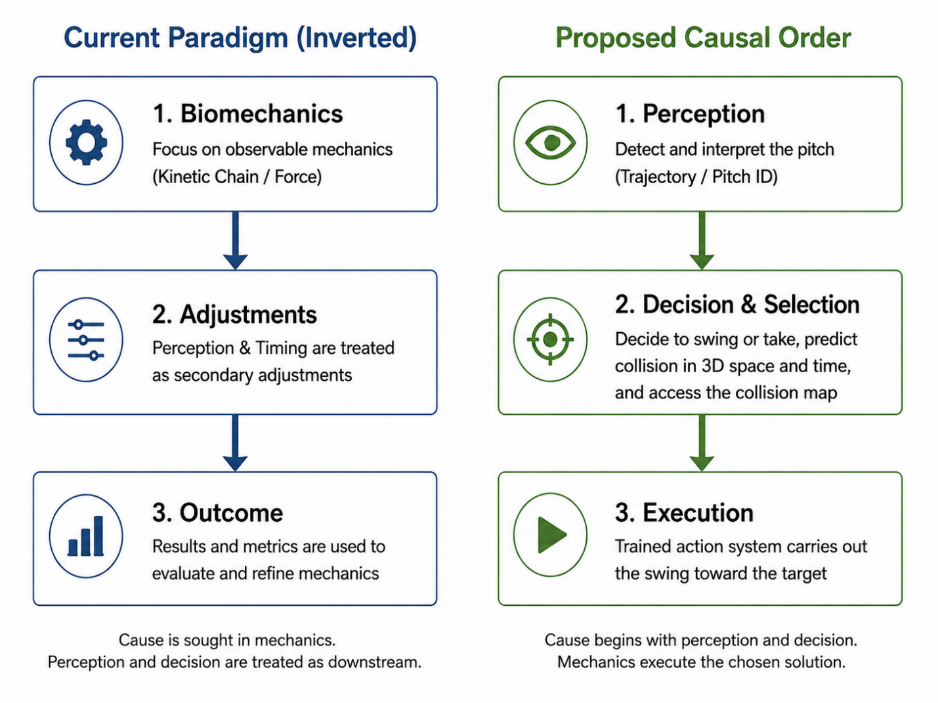
The current hitting paradigm is a locally coherent synthesis rather than a first-order conclusion. It combines visible swing traits, successful-player commonalities, biomechanical measurements, movement models, coaching language, and outcome statistics into a plausible explanation. Much of that work is valuable. Biomechanical analysis can refine an already workable movement solution by improving efficiency, clarifying swing-path relationships, strengthening ground-reaction-force production, and improving the transfer of energy through the body and into the bat. The problem arises when performance failure is treated as evidence that the established swing itself has become biomechanically inadequate and must be overhauled. Once that assumption became accepted, much of the field’s subsequent work remained inside it, becoming increasingly sophisticated at measuring bat path, kinematic sequence, body positions, force production, bat speed, and their relationships to outcomes while giving less consideration to whether perceptual, predictive, timing, and stress-related conditions produced the visible mechanical breakdown in the first place.
A Different Causal Order
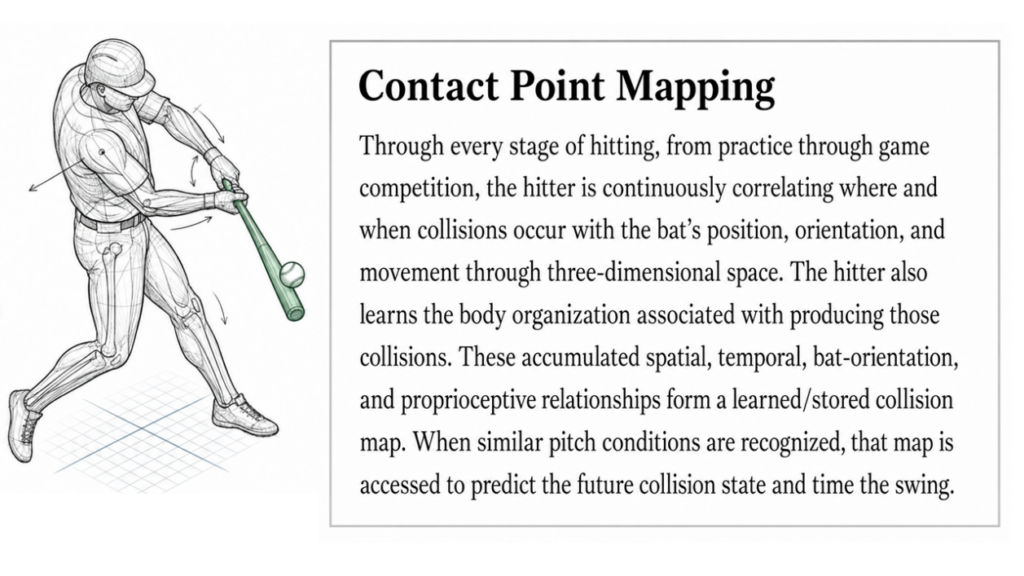
I arrived at a different conclusion because I continued past that assumption and questioned the mechanism itself. Before biomechanics can determine an outcome, the hitter must perceive the pitch, interpret it, estimate trajectory and location, decide whether to swing, determine when to initiate action, and predict where and when the bat must intersect the ball. That predicted collision point is resolved against a learned collision map accessed from memory, in which prior collision solutions are organized spatially and temporally in three dimensions.
The first-order question is therefore not simply how the hitter should move. It is what the hitter must know, detect, predict, and control before any movement solution can succeed.
I separate this process into two operational systems:
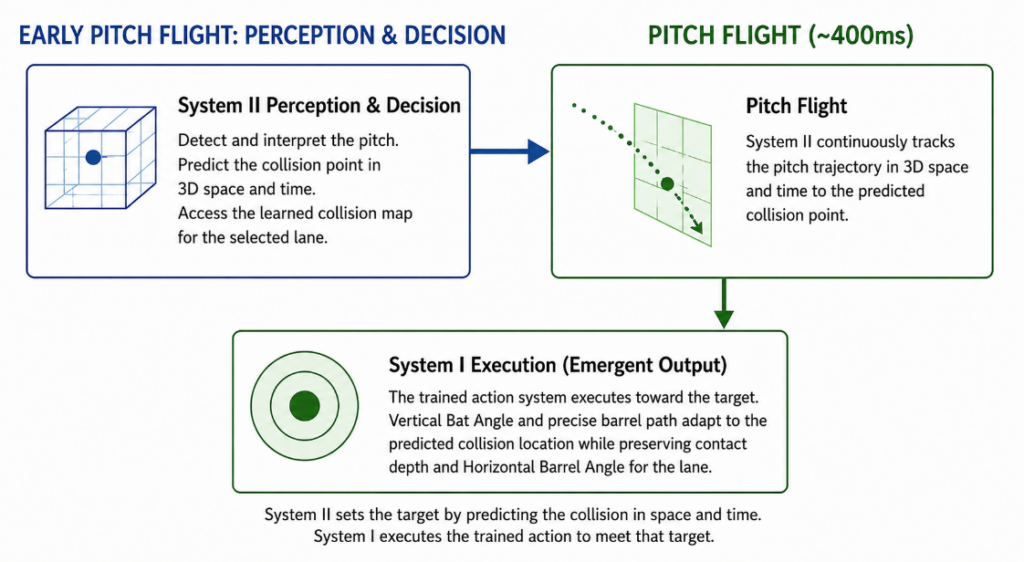
System One is the action or automaticity layer. It includes the trained movement patterns developed through practice:
- Swing biomechanics
- Posture
- Movement sequencing
- Proprioceptive control required to execute the action without deliberate mechanical thought
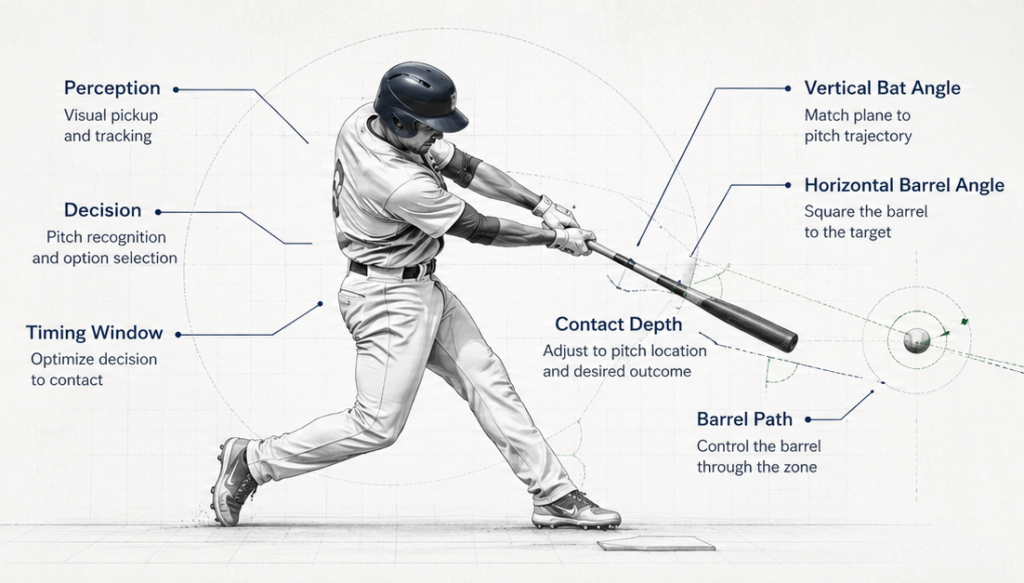
Not every feature of the resulting action is reproduced from a fixed motor pattern. The hitter may express a repeatable underlying swing organization, while the precise barrel path and Vertical Bat Angle adapt to the required collision solution. Intent operates as a second-order objective within that solution, shaping the desired direction and quality of ball flight and, in turn, influencing the swing path and barrel state expressed at contact. These are not separately rehearsed mechanical positions or default paths that should be retrofitted into the swing. Once the first-order constraint is resolved, they emerge as the trained action responds to the spatial and temporal constraints of the pitch and the intended outcome.
System Two is perception and decision. It includes:
- Detecting and interpreting pitch information
- Estimating trajectory and location
- Determining timing
- Making the swing or take decision
When the decision is to swing, System Two accesses the learned, encoded collision map associated with the predicted pitch location. That map supplies a largely stable targeting lane defined by contact depth and Horizontal Barrel Angle. As the predicted vertical position of the collision changes, Vertical Bat Angle and the precise barrel path adapt within that lane, allowing the automatic swing to reach the required collision point in three-dimensional space and time.
When Mechanics Describe Rather Than Explain
The governing mechanism of hitting is therefore not the swing alone. These hitters had already demonstrated, long before entering professional baseball, that their swings could solve the collision-physics problem at an elite level. The physical requirements of that collision did not change when they advanced. If the established swing begins producing inferior results, the first assumption should not be that the mechanical solution suddenly became fundamentally defective.
When the visible swing is assumed to be the culprit of the degraded results, coaches and analysts may prescribe changes based on how the movement deviates from an idealized biomechanical blueprint. Descriptive measures such as Vertical Bat Angle, attack angle, bat path, and body positions are often reverse-engineered into movement patterns intended to produce a desired result. This treats context-dependent barrel states as mechanical templates thereby attempting to retrofit ball-flight control onto a swing that had already demonstrated high-level collision ability.
Those barrel states are better understood as emergent expressions of the collision being attempted. Once the first-order constraint, timing the swing to the pitch, has been resolved, intent can shape the desired direction and quality of ball flight. The resulting swing path and barrel geometry reflect collision depth, vertical location, pitch trajectory, and the intended outcome. Their value lies not in matching a preferred number independently, but in how effectively they serve the collision.
Swing-Plane Alignment and the Cost of Fixed Paths
One of the most consequential examples of retrofitting descriptive metrics onto an established swing is the attempt to engineer a preferred attack angle through a prescribed swing-path change. This is not merely a way of measuring the swing. It is a common mechanical intervention that can alter the hitter’s underlying movement solution and potentially diminish the adaptability that made the swing successful in the first place.
Attack angle is a descriptive measurement of the bat at a particular, instantaneous moment in a particular collision. It does not, by itself, reveal the path the bat followed or establish the path a hitter should reproduce. Yet preferred attack-angle values are often reverse-engineered into fixed paths intended to manufacture those values across changing pitch conditions.
That approach turns a context-dependent barrel state into a standing mechanical order. Attack angle varies with pitch location, collision depth, pitch trajectory, timing, and the hitter’s intent. It may emerge from the circumstances of the collision and the intended direction of ball flight rather than from a predetermined path designed to create it.
When the swing is reorganized around an idealized attack angle, the prescribed path may no longer align naturally with the collision being attempted. The bat can follow that path consistently while remaining poorly aligned with the pitch trajectory at the required depth and location. A movement change intended to improve the swing can therefore reduce the hitter’s ability to adapt across the collision space.
Success then becomes increasingly dependent on precise offset between the bat and ball. A more closely aligned bat and pitch path preserves a longer interval in which collision can occur. A misaligned path reduces that opportunity to a narrower point in space and time, requiring greater precision in timing and offset.
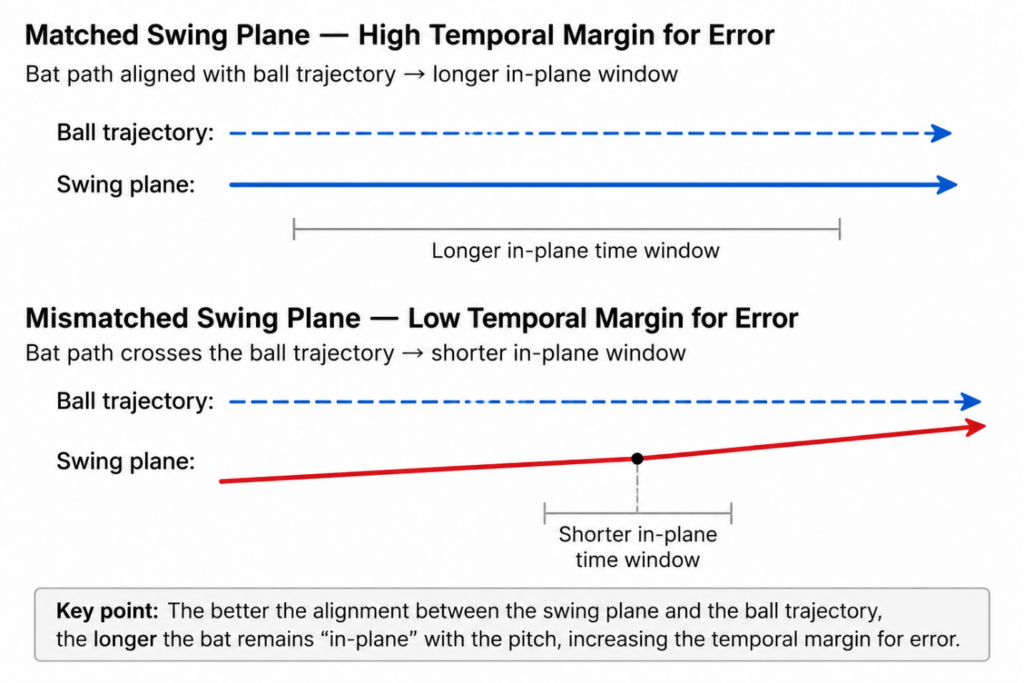
The objective should therefore not be to manufacture a preferred attack angle through a fixed default path. It should be to preserve an adaptable swing organization from which the appropriate path and barrel state can emerge in response to pitch location, collision depth, trajectory, timing, and intent.
Scientific Grounding and Falsifiability
The distinction between refining movement and mistaking a visible mechanical expression for the governing cause is central to this argument. It also raises a necessary question: what scientific basis supports placing perception, prediction, timing, and adaptive movement organization ahead of biomechanics in the causal order?
That causal distinction did not begin as an attempt to fit hitting into an existing scientific theory. It emerged through practical observation, experimentation, and problem-solving over 25-years of experience in the batting cages. Only after arriving at these conclusions did I search the scientific literature for evidence that could prove me wrong. More often than not, I found established science describing the same underlying structure in different language.
I’d already separated perception and action into distinct operating functions before reading Daniel Kahneman. I repurposed the System One and System Two labels from Kahneman because they gave recognizable scientific labels to a distinction I had already made, just as Kahneman had repurposed the terms from Stanovich and West. I borrowed those labels; I was not adopting Kahneman’s broader cognitive architecture.
The relationship is functional rather than literal. My System One retains the automatic, non-deliberative quality associated with Kahneman’s System One, but applies it specifically to encoded motor execution: swing biomechanics, sequencing, posture, and proprioceptive control. My System Two retains the evaluative and decision-making role associated with Kahneman’s System Two, but in hitting it must operate rapidly under severe time constraints. It detects and interprets pitch information, determines whether to swing, predicts where and when the collision must occur, and accesses the corresponding target within the encoded collision map. The definitions are therefore mine and specific to hitting, even though the labels preserve the broad distinction between automatic action and information-dependent decision.
The same pattern of independent theoretical convergence appeared when I later encountered Nikolai Bernstein’s work. Long before reading him, I had already concluded through observation and practical application that skilled movement could not be reduced to the repetition of one ideal mechanical pattern. What I observed instead was that each hitter’s movement solution reflected their individual strengths, weaknesses, and preferences, while the visible expression of that solution changed with the constraint confronting them.
For example, I recognized that when greater velocity, deceptive movement, or unresolved timing overwhelmed the hitter, the movement often regressed, sometimes resembling the more basic solution of a novice or early learner. The current paradigm generally treats that regression as the primary problem because it is the part that can be seen and measured. The conditions that produced it receive less consideration.
When the underlying constraint was reduced or resolved, however, the movement reorganized and became better optimized toward the higher-order objective of producing the intended outcome. Once the hitter could again resolve the pitch, the action could adapt to the collision being attempted and the intended direction and quality of ball flight. The objective was not identical movement. It was a stable action system capable of adapting to changing pitch conditions while preserving control over the collision.
Bernstein’s work on degrees of freedom, movement organization, variability, and skilled refinement did not create that conclusion for me. It gave scientific support to a pattern I had already observed in practice.
Conclusion
My theory is not offered as intuition, belief, or alternative truth. It’s falsifiable. If differences in perception, timing, and collision-space prediction do not explain meaningful variation in hitting outcomes beyond physical ability and biomechanics, the theory is weakened. If mechanical intervention consistently restores performance without resolving those first-order constraints, the proposed causal hierarchy becomes less necessary. If perceptual and timing failures do not influence collision errors or the mechanical expressions associated with them, the causal order I propose can be challenged. If training the first-order constraints does not transfer to improved timing, collision geometry, swing decisions, or competitive performance, the practical value of the theory must be reconsidered.
However, the prevailing paradigm should be held to the same standard. Familiarity does not make it complete, and consensus does not transform synthesis into causal proof. A field can become highly sophisticated within an incomplete frame, producing greater precision without greater explanatory power. In hitting, perception, timing, deception, uncertainty, and collision-space prediction remain fragmented areas of study rather than the organizing foundation of the model. Biomechanics are then used to explain failures that may have originated before the swing was initiated or the collision target was accurately resolved.
The biomechanical observations are not necessarily false. The measurements may accurately describe what the hitter did. The problem is that description does not establish causation, and those observations may have been organized around the wrong governing mechanism. A paradigm can become so detailed within its own boundaries that the boundaries themselves escape examination.
I’m not asking anyone to discard biomechanics or replace one unquestioned doctrine with another. Biomechanical analysis and training remain essential to refining an already proven movement solution. Improving ground-force production and conversion, increasing bat speed, maintaining sequencing, strengthening physical capacity, and reducing unnecessary inefficiencies can all enhance the hitter without reconstructing the motor plan that made the hitter successful. These should be front-line biomechanical objectives when the underlying movement solution is already functional.
I’m asking the hitting community to reconsider where biomechanical knowledge belongs within the causal order and how it should be applied. Biomechanics should enhance the action system where appropriate, not automatically replace it in response to movement changes that may have originated in perception, prediction, timing, or stress, nor should it reconstruct the swing around idealized outcomes reverse-engineered from descriptive metrics or theoretical models that give insufficient consideration to practical application and unintended consequences.
My theory should not be accepted because it is unconventional, and the prevailing paradigm should not be protected because it’s familiar. Both should be judged by causal coherence, explanatory power, predictive accuracy, practical transfer, and their ability to survive falsification.
This is not a contest between competing truths. It is a comparison between causal models describing the same reality. The question is which model identifies the governing constraint, explains why similarly talented hitters diverge, distinguishes causes from downstream mechanical expressions, and produces interventions that survive the conditions of competition. That is the standard I have applied to my own conclusions, and it’s the standard I am asking the hitting community to apply to the mechanism it has already accepted.