
Baseball's Launch Angle Revolution Redux – 2026
By Ken Cherryhomes ©2026
Introduction
This article is Part II of a broader examination of modern hitting development. Part I, When Analytics Become the Model, focused on the institutional side of the problem: how data, preferred metrics and biomechanical targets can evolve from useful measurements into prescriptive models that begin shaping the athlete around the metric rather than identifying the actual constraint.
Part II moves into the swing itself. It examines how swing path, barrel arc, attack angle and launch angle have become blurred together in modern instruction, how those distinctions affect timing, adjustability and collision geometry, and how Driveline’s pull-side lift philosophy fits into that framework. It also examines the data behind pulling outside pitches, including whether the added damage associated with successful elevated contact justifies the geometry, swing demands and failures required to produce it.
Have you ever wondered where the obsession with launch angles, attack angles and pull-side lift comes from? It’s one thing to say, “too many hitters today are swinging for the fences”. That’s an easy enough observation. The question that remains is, why?
A few years back, I wrote an article that was published by Inside Pitch magazine (May/June 2019) titled, In Pursuit of the Optimal Swing. It was an op-ed of sorts, to physicist Alan Nathan’s article, Optimizing the Swing, published by Hardball Times (Nov 2015). My article’s purpose was not to disprove Professor Nathan’s conclusions of optimal attack angle for maximum flight distance but rather, to offer perspectives not discussed in his article.
Optimizing the Swing was a chronicle of the theoretical physics involving bat swing attack angles (AA) and resultant batted ball launch angles (LA). To a theoretical physicist, the “how” component is of no concern, only the if/then conclusion. This is what has led to a bat swing paradigm focused on optimal batted ball launch angles, forsaking swing consistency and adaptability.
After having read Professor Nathan’s article, I reached out to him before writing my op-ed. We exchanged emails and had phone conversations that revealed he understood very little about bat swings and varying contact points outside of the controlled, fixed parameters in a vacuum.
I explained to him that he was likely, though perhaps unintentionally responsible for the current shift that has resulted in lowered batted balls and bolstered strikeout rates we are seeing today. I further explained downward swings or more direct, forward swing paths are arced paths, descending to ascending that arrive at different instantaneous attack angles based on the point of contact within that arc. I explained “down swings”, which are actually hand paths, are not intended to make contact while on the downward arc of a swung bat, and that making contact with a negative attack angle was generally the product of poor timing, not necessarily the shape of the arc. I stressed the importance of understanding how a bat arrives, the path the batter initiates to arrive at a desired attack angle, and the negative implications of not articulating this. His response was:

Embarrassingly, I was notedly incredulous at his response and his apparent indifference to the implications of his study. I went on to argue that, without consideration for application, leaving the means of achieving desired attack angles open to interpretation was irresponsible. So, I took it upon myself to educate the public. I feel that point was largely missed, which is why I am writing this article today.
That history is relevant in light of the recent CBS Sports examination of Driveline’s hitting philosophy and its consequences. Read it here: How a polarizing hitting approach took over MLB, and what happened when it stopped working for a top prospect.
Professor Alan Nathan has long advised Driveline on collision physics, including how a broadened swing arc can increase angular momentum and bat speed at collision. Those ideas helped shape Driveline’s later investigations into pull-side lift, including training prescriptions that encouraged hitters to create pull-side elevation even on pitches on the outer part of the plate. That connection resonates because the ideas now under scrutiny grew from a physics-based framework whose practical application to hitting carries important caveats beyond the physics itself.
What Exactly is Optimal?
When I use the word optimal describing bat swings, I consider more than the resulting outcome. I consider path directness, adjustability, natural ease of execution, probability of the desired outcome, consistency and margin of error. Something is optimal only when all relevant parameters are considered, not simply those that exist within fixed conditions.
Within a vacuum, assumptions can be applied for theoretical purposes, but the geometry of the collision, spray-angle consequences, pitch-location demands, consistency and swing constraints are not fully represented. Conclusions drawn without accounting for those variables and the execution required to produce them are little more than an if/then discussion. They are not a blueprint for how a hitter should actually swing.
The Ted Williams Fallacy
Ted Williams is difficult to avoid in any serious discussion of upward swing paths. Arguably the greatest hitter of all time, and still the last man to bat .400, Williams is often cited as an early advocate of swinging up.
The question is what Williams actually meant by an upward swing. In one sense, he did advocate it, but not in the exaggerated form often associated with launch-angle-conscious swings today.
Williams famously wrote that a slight upswing was best in The Science of Hitting. Yet a decade earlier, in 1961, the year after he retired, he described a level swing as best, said swinging down was not bad, and warned that swinging up was not good.
Ted Williams in his own words 1961
Here in 1974, 13-years after recommending a level swing is best, he describes the best swing is a slightly up swing.
Ted Williams From The Science of Hitting 1974
It’s important to note, Ted Williams was primarily a pull hitter. When pulling the ball, the bat’s barrel is meeting the ball out in front, where the barrel passes the hitter’s hands, turning towards their pull field and more importantly, regardless whether the swing path is down or level, it begins to naturally ascend at this point in the swing’s arc. I believe Ted understood this in 1961, which is why he recommended a level or downward swing path. Note: a swing path is generally associated with the batter’s hand path, not the barrel’s arc.
Here is a random sampling of Ted Williams’ in-game swing. You will not notice a defined upward swing path intended to produce steep attack angles prior to bat/ball collision in any of these swings.
In the clip below of Ted Williams, from his video, The science of Hitting, he demonstrates his swing, which he describes as a “slightly up swing”. You can observe his swing is actually extremely flat, level, throughout most of the swing’s arc and only at contact, where the bat begins its natural ascent, is it “slightly up”. This is the literal, visual representation of the difference between bat path, and attack angle. One is prolonged, the other, emergent and instantaneous.
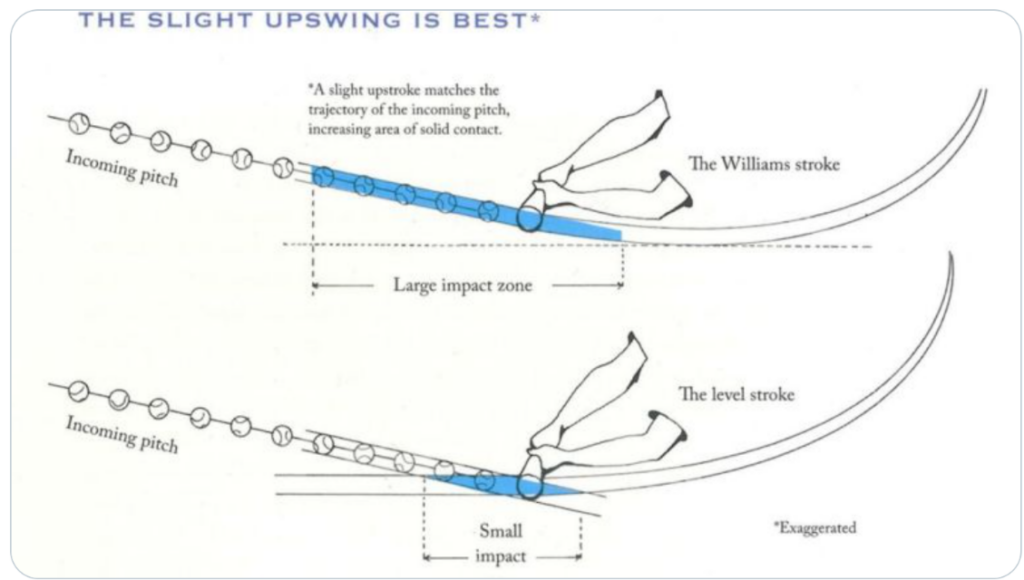
This famous image from The Science of Hitting is often used to support the upward-swing narrative. But the illustration itself is easy to overread. The two swings are essentially the same overall arc, with the colored portions emphasizing different segments through the contact zone.
Another important distinction is that the barrel path is not the same thing as the hitter’s hand path. During the turn, the barrel is typically below the hands and rotating around them, which means it can trace different arc shapes even when the hands themselves are moving on a relatively direct path. A rising barrel does not necessarily mean the hands are being driven upward.
Downward contact can also occur simply because collision happens earlier in the barrel’s arc, often as a function of timing and the ball arriving late in the swing sequence. For the barrel to continue traveling downward deeper into the contact region, however, the hitter would generally have to alter posture, move off axis, or apply substantial hand tension to prevent the barrel from naturally arcing upward. The bat can be delivered directly and still ascend through the collision region as a natural consequence of the swing’s geometry. “Swinging down on the ball” should not be confused with producing a continuously downward bat path with no arc. Swinging down is more of a cue, or perception than anything else, because the hitter’s hands almost always begin above the plane of the pitch.
The illustration also implies more forward travel of the barrel through the hitting zone than actually occurs. A baseball bat does not move forward like the head of a golf club. The barrel is turning around the hands as the swing progresses, so the sweet spot is being carried through space by both translation and rotation at the same time. That rotational component continuously changes where the barrel is and how it is oriented, which makes the actual impact window more complex than the straight-line depiction suggests.
The snapshots below from Williams’ video help clarify what he meant by a “slight upswing.” What Williams, and later Professor Nathan are describing is the instantaneous attack angle at the moment of collision. That’s a description of the barrel’s direction at one instant in time, not necessarily a prescription for the entire swing path leading into contact.
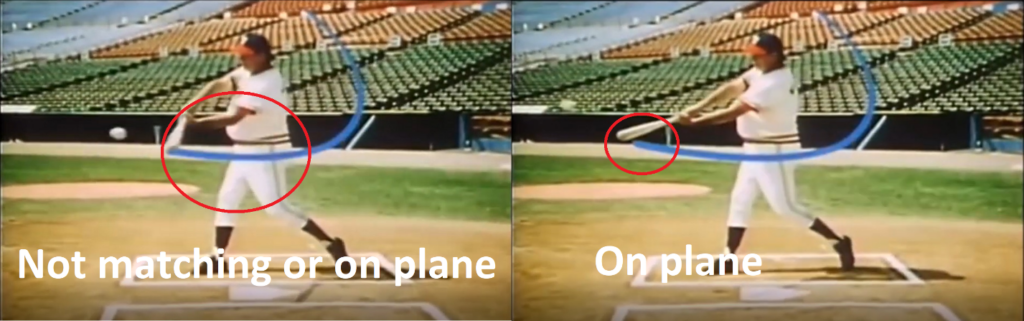
The above photos depict that only at the moment just before contact is Ted’s barrel matching the plane of the pitch.
Interpretation and Application of Optimal Launch Angle Engineered Swing Paths
The swing paradigm that followed bears little resemblance to Ted Williams’ actual swing. It more closely resembles the application of Professor Nathan’s theoretical work on optimal attack angle for maximum batted-ball flight distance of 18 degrees, as though that value could serve as a general swing prescription across pitch locations.
Note: Nathan’s study was based on striking a middle pitch to centerfield, which resulted in prescribed swing paths rather than allowing hitter intent to adjust the swing path. Hitting flyballs to centerfield is generally not the best idea.
In practice, that kind of theoretical optimum became a movement target. The hitter is asked to reproduce preferred attack angles, bat-speed values and launch conditions, even when the pitch itself may call for something different. That’s where the swing can begin to look and feel robotic. Adjustability narrows because the hitter is no longer simply solving the pitch. He’s trying to preserve a predetermined movement pattern built around preferred metrics.
The CBS Sports article on Driveline provides a useful real-world example of where that philosophy can lead. The training system described there reflects a broader tendency to build a blueprint swing around measurable outputs, then ask the hitter to fit himself to the model. The risk is that the model begins to dictate the movement instead of the pitch dictating the solution.
Remember, Williams was famously a dead-pull hitter. Forward contact naturally places the barrel farther into its ascending arc, producing steeper attack angles. Pulling middle and inside pitches does the same thing as a consequence of pitch location, contact depth and swing geometry. In those situations, a steeper attack angle can emerge naturally from the physics of the swing rather than from a deliberate attempt to manufacture one.
Nathan also acknowledged an important limitation in his own work: Higher attack angles may produce slightly greater maximum flight distance, but lower attack angles can still produce optimal launch angles with a larger margin for error. “Slightly” is the operative word. His exercise was designed to determine maximum flight distance, not the most adjustable, repeatable or executable swing across changing pitch location, timing and intent.
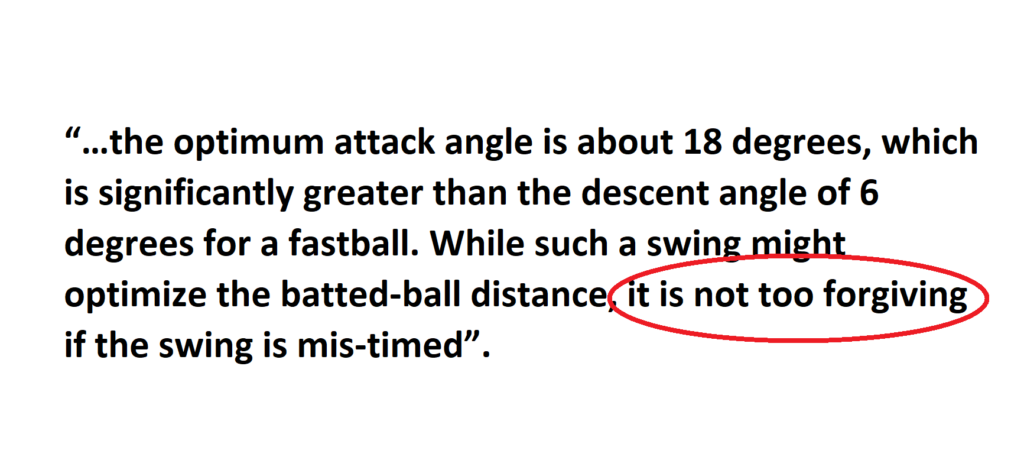
The problem, as Professor Nathan acknowledged, is that an 18-degree attack angle is not particularly forgiving when the swing is mistimed. But timing is only half of the problem. A hitter can time the collision perfectly and still produce an undesirable result because steep attack angles are also highly sensitive to offset.
If the intended collision is built around roughly a 1-inch offset, reducing that offset to 1/2 inch, even with perfect timing, can change the spin relationship enough to produce topspin and, at 1/4 inch of offset, a routine fly ball, even at extreme exit velocities due to topspin. A perfectly timed, flush collision at zero offset can produce a ground ball. Basically, the margin for error is being squeezed from two directions at once: timing and offset.
The hitter isn’t simply being asked to arrive on time with a steep path. He is being asked to arrive on time and at a very specific geometric relationship between bat and ball in order to produce the desired launch and spin. Once those constraints are coupled, engineering a swing path around steep attack angles begins to look like a pursuit of a unicorn. The reward may be substantial when every condition aligns, but the number of conditions that must align increases while the hitter’s margin for error decreases.
My study In Pursuit of the Optimal Swing compared a 17-degree attack angle to a 0-degree attack angle on a middle pitch intended to be driven to center field, using the same basic conditions as Professor Nathan’s study. I chose 0 degrees because a naturally downward-arcing swing can reach that orientation, the “leveling” or flattening of the arc, just before the barrel passes the hands and begins to ascend, without any applied intent to create lift.
Depending on contact depth, that same swing can later produce an attack angle near 18 degrees without the hitter deliberately creating an upward swing. As the barrel continues through its natural arc and contact occurs farther out in front, the attack angle steepens naturally. Pulling middle and inside pitches often creates those conditions as a consequence of pitch location, contact depth and swing geometry, rather than from a hitter consciously trying to manufacture a steep upward path.
Hank Aaron swinging down while making contact as the bat ascends.
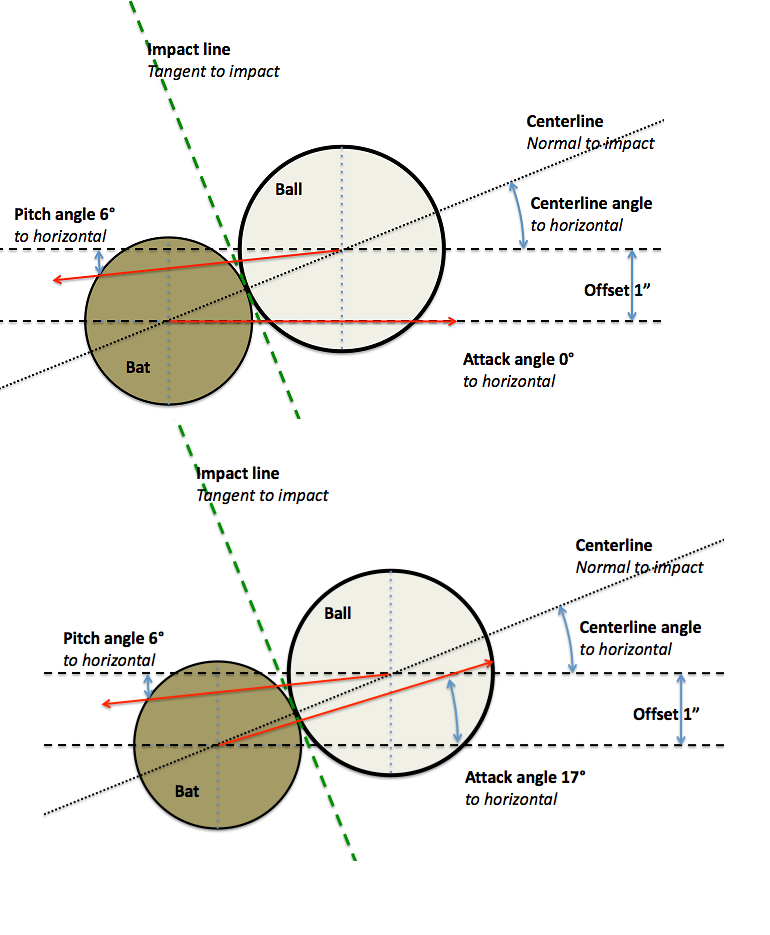
My study did not disprove Alan’s conclusions, nor was it intended to. My purpose was to show that a swing with greater margin for error and greater potential for positive outcomes could still produce nearly the same flight distance. More importantly, as previously noted, a swing that maintains a consistently lower attack angle through most of its arc can still reach an optimal attack angle of 18 degrees when contact occurs farther forward along that arc, e.g., on inside pitches. Early pitch recognition and timing also allow the hitter to apply intent to the swing without locking into a predefined path. Wrist articulation and barrel orientation can then adjust the attack angle to match pitch location, contact depth and pull-side geometry, preserving adaptability while still producing the steeper attack angles associated with forward contact. The hitter does not need to build the entire swing around a rigid upward path to achieve a steep attack angle at collision.
The swing model commonly used today in pursuit of maximum flight distance bears little resemblance to Ted Williams’ actual swing. Williams’ relatively level, naturally arcing path has increasingly been replaced by higher attack-angle approaches applied across pitch locations rather than allowing attack angle to emerge from the geometry of the pitch and the hitter’s intent. The result is a more rigid swing model that reduces adjustability and encourages hitters to chase preferred metrics rather than solve the pitch in front of them.
When the Blueprint Meets the Game
The CBS Sports article places Driveline’s hitting philosophy inside a much larger shift in player development. The emphasis on bat speed, altered swing paths and pull-side elevation has moved well beyond one facility or one hitter. It has influenced organizational development systems and helped define what a modern “optimal” swing is supposed to look like.
The broader results deserve the same scrutiny. More home runs are being hit, but strikeouts and ground balls have also increased, while runs scored per nine innings remain slightly below the pre-launch-angle era. More ground balls, despite one of the central objectives of the launch-angle movement aimed to avoid them.
Here’s why:
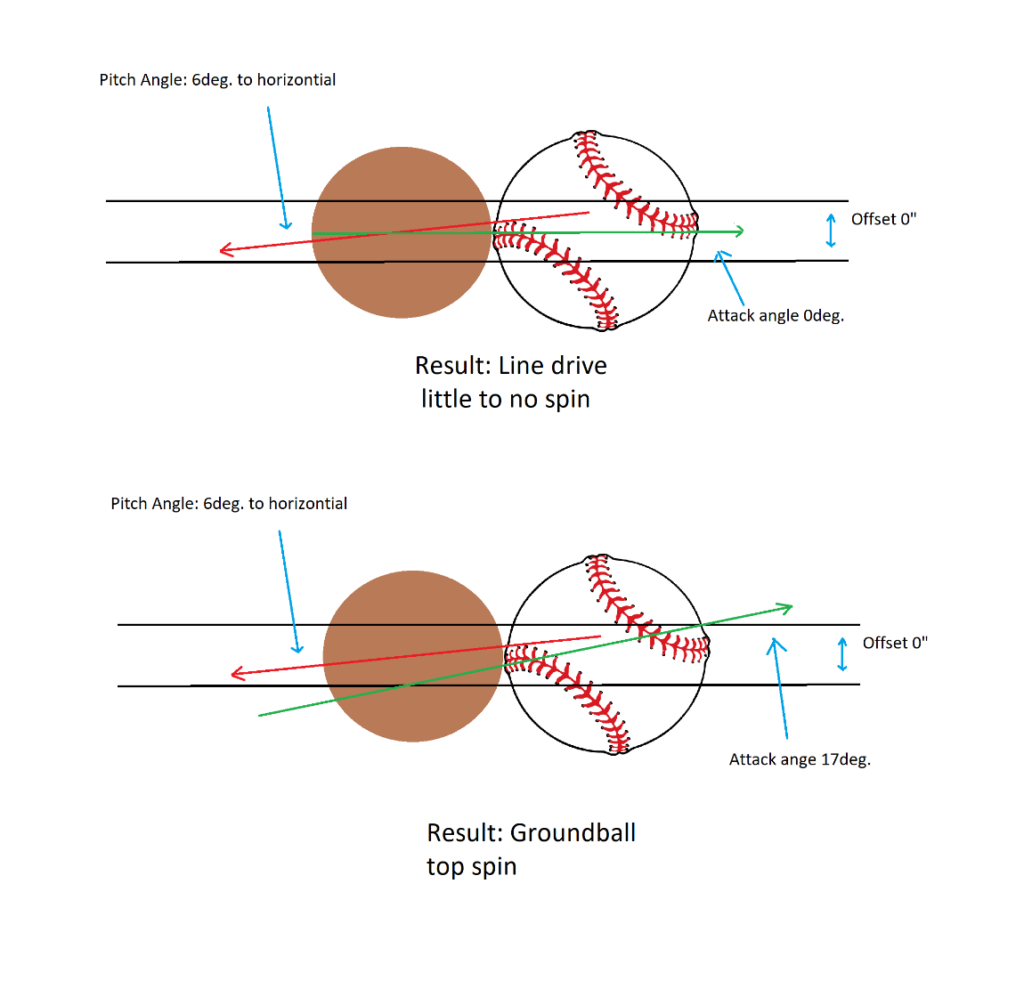
While the point of contact between the bat and ball is identical in the two swings illustrated above, both collisions also occur at zero offset. At a 0-degree attack angle, the descending pitch produces a line drive up the middle with backspin. At a 17-degree attack angle, the same zero-offset collision produces a ground ball up the middle with topspin, precisely the type of outcome the high attack-angle swing is intended to avoid.
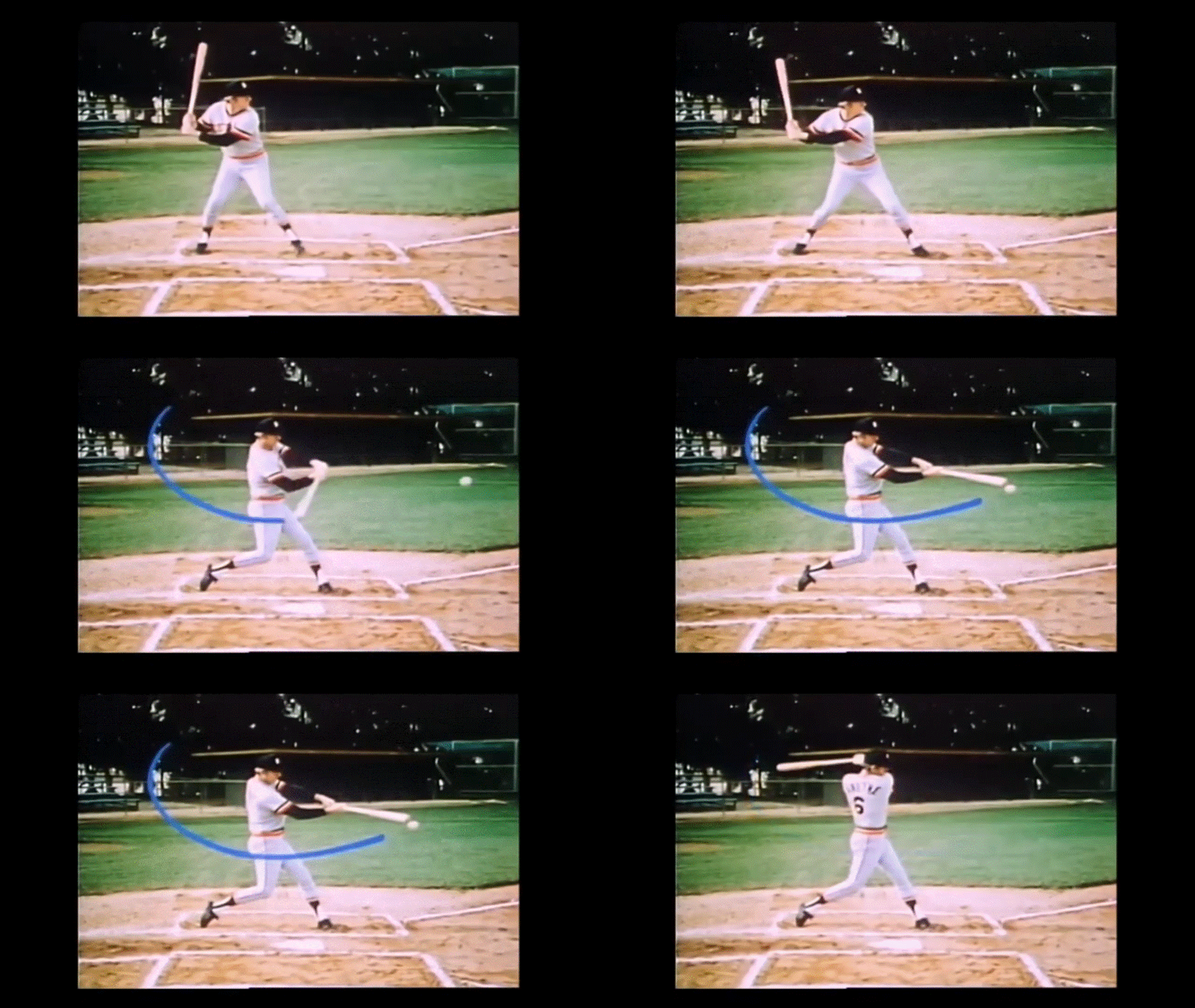
Ironically, from The Science of Hitting Al Kaline top spin grounder from a steep attack angle
A steep upward attack angle also narrows the line-drive window. Producing a line drive, particularly one with backspin, becomes increasingly difficult as the attack angle steepens because the collision geometry must become more precise. Fly balls may offer the greatest home-run potential, but they also produce a much lower rate of base-hit success. Line drives occur less frequently, yet they produce the highest rate of successful outcomes.
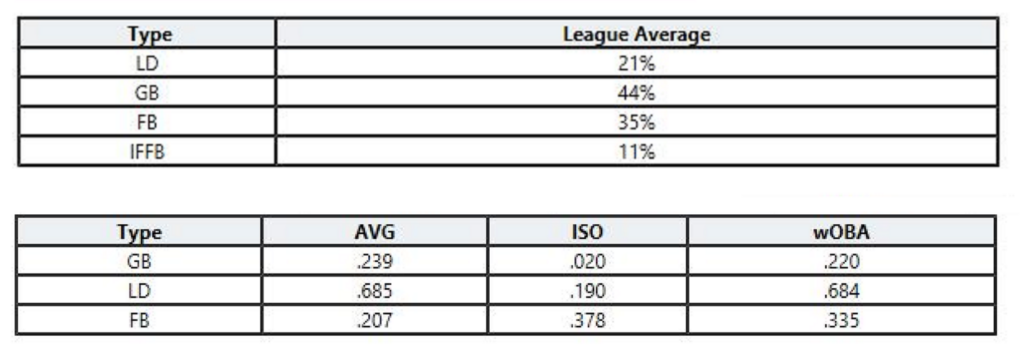
The batted-ball data exposes the tradeoff behind Driveline’s metric-driven elevation model. Line drives remain the least frequent major batted-ball type, yet they produce the highest rate of successful outcomes by a wide margin. Fly balls carry the greatest home-run potential, but they also become hits far less often. More troubling, the CBS Sports article describes hitters trained to create more air who nevertheless developed increased ground-ball problems, along with reduced adjustability and swings that could begin to feel robotic. That outcome echoes the attack-angle example from the previous section, where increasing attack angle alone turned a backspin line drive into a topspin ground ball under otherwise identical pitch and offset conditions.
That tradeoff is central to Driveline’s emphasis on bat speed, pull-side lift and preferred attack angles. A training model built around those outputs can improve selected metrics while narrowing the hitter’s range of solutions. The better question is not simply how to create more lift, but how to preserve adjustability, produce more line drives and still allow elevation when pitch location, contact depth and intent support it.
The collision physics do not always require a steep upward swing or attack angle to create flight, either. Because both the bat and ball are round, most collisions occur with some degree of tangency. Pitch angle, attack angle and offset determine whether the ball leaves with topspin or backspin and whether its launch angle is positive or negative. A pitch descending at roughly 6 degrees can be struck at a 0-degree attack angle and zero offset and still produce a line drive with backspin. Under the same pitch and offset conditions, raising the attack angle to 17 or 18 degrees can instead produce topspin and a ground ball.
The Cost of Pulling the Outside Pitch
From 2026 SABR Analytics Conference Q&A
Following my Causal Analytics presentation at the 2026 SABR Analytics Conference, during the Q&A, a Driveline representative posited whether a hitter should contact an outside pitch farther out front to extend the barrel’s acceleration path to generate additional bat speed. He noted that they [Driveline] were conducting a similar analysis of attack angle and approach angle. My response was direct: greater bat speed does not compensate for putting the barrel into a geometrically inferior collision.
That question sits squarely within the pull-side lift philosophy examined in the CBS Sports article. From 2021 through the present, 50,014 knee-high, thigh-high, belt-high and numbers-high outside pitches were pulled into play.
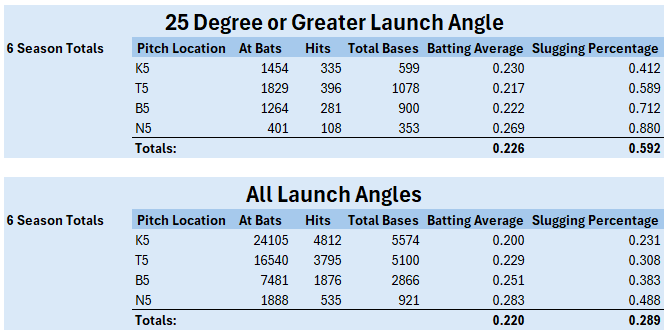
Across all launch angles, those balls produced a .220 batting average and .289 slugging percentage. Of those, 4,948 were launched at 25 degrees or higher, producing a .226 batting average and .592 slugging percentage.
The damage is obvious, but so is the frequency. Elevated contact at 25 degrees or higher accounts for only 9.9 percent of all pulled outside balls. At B5, the belt-high outside location, 16.9 percent of pulled contact was launched at 25 degrees or higher, yet that subset produced 31.4 percent of the total bases. When the hitter gets the desired result, the reward can be substantial. The desired result itself remains relatively uncommon.
Those numbers, however, describe only balls successfully put into play. Across those same outside-pitch locations, hitters also recorded 82,449 strikeouts, compared with only 50,014 balls successfully pulled into play. That does not mean those strikeouts were caused by an attempt to pull or elevate the pitch. It illustrates something more fundamental: the outside part of the plate is already a costly place to hunt for an aggressive offensive outcome. Building an additional pull-side elevation requirement onto an already difficult pitch location further narrows the geometry the hitter must solve.
That broader denominator is especially relevant when evaluating an engineered swing built around steep attack angles and pull-side elevation. Pulling an outside pitch already requires the hitter to solve a more demanding geometric problem, and the flatter vertical bat angles required in many of those successful collisions are not naturally supported by a rigidly steep swing prescription. The positive elevated outcomes therefore should not automatically be credited to the engineered path itself. The dataset includes hitters with different swing organizations and different intentions, many of whom are not chasing steep attack angles at all.
The reward side of the equation is real. So is the cost. A philosophy built around the damage created by the successful elevated pull can look compelling when the analysis begins at contact. Once the swings that never produce contact are restored to the denominator, the probability of realizing that outcome becomes considerably smaller.
Conclusion
The mistake, as I have pointed out, is treating attack angle as a swing-path prescription rather than an instantaneous condition at collision. Swing path, barrel arc, contact depth, timing and intent all shape how the bat arrives at the ball, and those relationships are dynamic because the pitch itself is moving through space. Unlike golf, from which many modern bat-swing measurements and concepts are borrowed, baseball does not present the hitter with a stationary ball and a fixed impact condition. Pitch location, trajectory and timing continuously alter the geometry the hitter must solve. A hitter can produce steep attack angles when the geometry calls for them without organizing every swing around a steep upward path. The objective should be to tend to the athlete who was drafted for his existing ability to hit, identify the actual constraint, and preserve the adjustability and athleticism that got him there rather than reconstruct the swing around preferred metrics.
The outside-pitch data reinforces that point. Pull-side lift can produce damage when the hitter succeeds, but the desired outcome occurs infrequently and becomes far less compelling once strikeouts are included. A narrow focus on selected metrics can make the reward look larger than it is while obscuring the execution cost required to produce it. The numbers themselves may be accurate, yet still provide an incomplete description of the event when timing, pitch location, collision geometry, swing adaptability and failed attempts are left outside the analysis.
That is where limited domain knowledge can unintentionally manipulate the meaning of otherwise valid data. The problem is not necessarily that the measurement is wrong, but that the question is incomplete, the denominator is too narrow, or the physical context required to interpret the result is missing. A model built from those omissions can then become a prescription, and the prescription can create risks that outweigh the metric it was designed to improve.
The better model is one in which data identify the problem, baseball knowledge supplies the context, and timing, recognition, intent and collision geometry determine the swing that the pitch requires.