
X Factor Research Proposal
Can Timing in Complex Motor Tasks Be Systematically Taught and Accelerated- An Exploration of Cue-Based Errorless Training
By Ken Cherryhomes © 2023, 2024, 2025, 2026
Abstract
The objective of this study is to investigate whether baseball batter swing timing can be systematically taught and accelerated through cue-based errorless training. Timing is a critical aspect of successful hitting, and improving it could significantly enhance offensive performance. However, existing training methods rely heavily on trial-and-error learning and innate ability, falling short in providing objective and standardized approaches to address timing challenges.
This research treats timing as the first-order constraint in the hitting task. Across skill levels, batters generally enter training with an existing motor plan that is sufficient to produce a swing, but that motor plan cannot be consistently optimized until it is synchronized with the collision window created by a moving pitch. Modern training often engineers swing optimization while leaving timing to emerge through repetition. This study reverses that order by first addressing whether the primary timing constraint can be solved directly.
This research seeks to answer two key questions: Can swing timing, specifically the coordination of user-controlled actions with predicted object trajectories, be taught in a controlled, systematic manner? And does providing precise, actionable timing cues bypass the limitations of trial-and-error learning to achieve faster skill acquisition and lasting memory consolidation?
By harnessing innovative technologies, including batter-specific time-domain metrics and live pitch kinematics capture systems, augmented by advanced algorithms, the proposed method delivers mathematically precise timing cues tailored to individual batters. This comprehensive approach investigates the mechanisms by which batter swing timing can be systematically taught and internalized, addressing foundational cognitive and motor learning questions while advancing our understanding of timing coordination in baseball. Once the primary timing constraint is reduced, the study further examines whether the batter’s existing motor plan can organize more effectively around the collision task, allowing swing optimization and batted-ball output to follow from a solved timing condition rather than from biomechanical correction alone.
Introduction
Baseball player development often hinges on factors beyond physical skill and athleticism, especially when those traits are comparable within a group. A critical differentiator lies in the cognitive timing ability that separates hitters not only across levels of competition, but also within the highest levels themselves. Even among players who have successfully reached elite competition, the ability to predict ball arrival, initiate the swing on time, and consistently organize contact around the correct collision window is not equally distributed. While physical talents can be scouted, projected, and developed, this elusive cognitive aspect remains a mystery, only revealing itself when challenged under elite, high-stress conditions. Successful hitting requires the seamless integration of two primary tasks: the physical execution of the swing and the cognitive prediction of the ball’s arrival. Batters must execute complex motor actions while engaging in real-time decision-making to predict the optimal moment and location for bat-ball contact.
These two tasks, however, are not equal-order problems. Across skill levels, the batter typically enters training with an existing motor plan that is workable enough to produce a swing. The more difficult developmental problem is synchronizing that motor plan with the moving pitch. Timing is therefore treated in this study as the first-order constraint. This makes timing a uniquely useful training target because, once a basic motor plan exists, timing is largely mechanically agnostic. It can be measured and trained without prescribing a specific swing philosophy. Until the hitter solves when the swing must be initiated to meet the collision window, swing optimization remains unstable. Poor timing will not reliably resolve through biomechanical optimization first. Under live-speed constraint, mechanics often deteriorate toward base movement patterns and compensation strategies until the primary timing constraint is solved.
The limited ability to accurately project a player’s hitting potential underscores the significance of this cognitive factor. Traditional player paths highlight a steep talent attrition rate: in the United States alone, approximately 20 million core baseball players participate between the ages of 6 and 12. By high school, this number drastically reduces to roughly 550,000 core players. This drop-off can be heavily attributed to the escalating difficulty of mastering hitting skills. As young athletes encounter challenges in developing batting precision, many opt out of the sport entirely.
The historical lack of objective and standardized training methods means that innately gifted players naturally rise to the top, while others with tremendous potential remain untapped. A central limitation of modern hitting instruction is that swing optimization is often engineered while timing is left to trial-and-error repetition. This reverses the development task order. In light of these challenges, this research introduces a novel training methodology designed to improve batter timing by providing precise, actionable solutions that bypass the limitations of trial-and-error learning to accelerate skill acquisition. Once the primary timing constraint is reduced, the hitter’s existing motor plan may organize more effectively around the collision task, allowing mechanical refinement and batted-ball optimization to follow from a solved timing condition. Elevating players who may not be innately inclined and enhancing the cognitive mechanics of those who possess this latent timing ability has the potential to fundamentally reshape player development paradigms.
Thesis
This study argues that baseball swing timing is the first-order constraint in the hitting task. Across skill levels, the batter typically enters training with an existing motor plan that is workable enough to produce a swing. The primary developmental problem is not the absence of movement, but the synchronization of that movement with the collision window created by a high-velocity moving pitch.
Modern hitting instruction often reverses the proper development order by engineering swing optimization while leaving timing to trial-and-error repetition. This study takes the opposite position. In an interceptive motor task, the timing constraint must be solved first. Once the hitter understands when the existing motor plan must be initiated to meet the pitch at the intended collision point, mechanical organization and batted-ball optimization can follow.
Poor timing will not reliably resolve through biomechanical optimization alone. When the collision window remains uncertain, the hitter is forced to compensate around late, early, or unstable arrival. Under live-speed constraint, mechanics tend to deteriorate toward base movement patterns until timing is solved. The purpose of cue-based errorless training is therefore to reduce the timing constraint directly, allowing the batter’s existing motor plan to organize more effectively around the collision task.
Theoretical Framework and Cognitive Mechanisms
Mastering a high-velocity interceptive task requires the rapid integration of spatial perception, memory encoding, and motor execution. In this study, memory encoding refers to the process by which the batter transforms incoming timing and spatial information into a usable internal reference for future swings. The hippocampus is central to the initial formation of spatial and object-recognition memory, providing a plausible memory system through which repeated timing solutions can be encoded into a stable route-like representation1.
A real-world analog for this type of cue-guided learning is simulator-based driver training. Driving simulators use real-time visual, auditory, and haptic cues to guide behavior under controlled risk conditions, and systematic review evidence supports the training value of driving simulators for improving driver performance and safety under controlled conditions2.
Because timing training depends on more than momentary performance, the framework also draws on two complementary theories of memory consolidation. Synaptic consolidation explains how repeated successful actions strengthen neural connections, while systems consolidation explains how memories become integrated into broader long-term networks3,4.
This study applies a synergistic framework of cue-based errorless training to reduce instructional variance and minimize trial-and-error discovery. Errorless learning, pioneered by Charles Ferster and later framed in educational learning literature, rejects the premise that errors are necessary for effective learning. Instead, learners are guided to acquire correct information and actions from the outset5. By utilizing auditory, visual, or haptic signals to prompt action during the precise phase of execution, cue-based errorless training eliminates guesswork and uncertainty during the earliest stage of learning.
The framework also draws on chunking theory. Through practice, performers group dense spatial and temporal information into larger, meaningful units. In baseball, this means learning to chunk pitch location, predicted arrival, collision depth, and swing initiation into a usable action unit6. The real-time cues in this study are designed to accelerate that chunking process by directly solving decision timing and focusing training on key temporal-spatial moments7. Moreover, minimizing errors during learning has been associated with more effective memory encoding, supporting the logic of an errorless timing intervention8.
Cue-based training has supporting analogs across other skill domains. Cueing has been reported to improve basketball shooting accuracy9, visual cue training has been used to improve complex gross motor task performance in children with developmental coordination disorder10, and errorless learning research has compared errorless and errorful learning conditions in precision motor tasks11. Auditory interfaces have also been proposed as practical timing channels in automated driving contexts12. These sources do not prove the present baseball intervention, but they support the plausibility of cue-guided training as a legitimate behavioral and motor-learning strategy.
During initial skill acquisition, performers commonly reduce degrees of freedom so they can solve the primary task constraint before adding complexity. That principle is directly relevant here: timing is treated as the primary constraint to be solved first, after which the hitter may have greater freedom to optimize swing organization and batted-ball output13. The framework also acknowledges that error elimination can fail under some learning conditions, which is why this protocol uses deterministic timing cues to reduce avoidable early errors rather than merely documenting them after the fact14.
The proposed neural interpretation is that the posterior parietal cortex functions as a sensorimotor transformation layer connecting spatial perception to motor execution15. The hippocampal system supports stored route-like memory for spatial navigation and timing solutions16, while parietal-frontal systems support common reference frames, intention, action planning, and decision-making for visually guided movement17,18. The system’s keystone timing reference is also consistent with internal-model accounts of sensorimotor integration19.
Within that structure, the Bayesian Learning Model provides a computational explanation for how batters refine internal timing estimates. In unguided interception, the brain must reconcile uncertain sensory evidence with internal state to estimate when to commit. Here, the deterministic cue functions as a high-fidelity synthetic prior that narrows the solution space at the decision point20. The Swing Alert System does not perform Bayesian updating itself; rather, it provides a precomputed timing solution that the batter can internalize through proprioceptive confirmation at contact.
Once successful contact confirms the validity of the imposed timing solution, proprioceptive feedback reinforces the learned temporal-spatial relationship. The batter receives sensory confirmation of bat orientation, contact depth, and timing alignment. Over repeated successful trials, the cue-guided solution can be encoded as a usable timing reference, while the motor plan remains free to self-optimize around the now-reduced timing constraint.
Research Questions & Hypotheses
Research Questions
- Does errorless training lead to accelerated memory encoding in baseball batters, resulting in improved interception timing and performance?
- What are the differences in skill acquisition rates and performance outcomes between errorless training and traditional trial-and-error methods?
- Can timing, specifically the coordination of intersecting independent objects (one user-controlled, one predicted), be taught in a controlled, systematic manner?
- Does providing precise, actionable solutions (via cues) shorten the time required to encode the temporal-spatial relationship between the user’s action and the predicted trajectory of the object?
- Does this acceleration lead to lasting memory consolidation for the learned timing?
- Operational clarification: In the present protocol, this question is tested as immediate and short-term retention after cue removal. Long-term retention and far-transfer should be addressed in a subsequent longitudinal study.
Hypotheses
- Hypothesis 1: We hypothesize that errorless training will lead to improved and accelerated memory encoding, allowing baseball batters to predict and intercept pitched balls more accurately, thereby enhancing their batting performance.
- Hypothesis 2: We predict that cue/signal-based training methods will effectively synchronize the batter’s swing, regardless of mechanical swing philosophy, with the arrival of the pitched ball, leading to increased on-time swings and improved batting accuracy.
- Hypothesis 3: We further expect mechanical swing efficiency will improve, including greater control of swing attack and launch angles, for batters who are less confounded by timing, enabling them to reorganize and/or adjust, optimizing their swing mechanics to fulfill a second objective/intention of maximizing batted ball results.
- Hypothesis 4: We anticipate that errorless training will outperform traditional trial-and-error methods in terms of skill acquisition rate and overall performance improvement.
- Hypothesis 5: We hypothesize that cue-based errorless training will lead to significant improvements in both the physical execution of the swing and the cognitive prediction of bat-ball contact timing, demonstrating superior performance in dual-task scenarios where motor plans self-optimize when constraints are removed.
- Operational clarification: Hypothesis 5 is evaluated through immediate post-intervention testing, cue-removal performance, and randomized-location short-term retention. It does not claim proof of long-term retention or long-term transfer from the present protocol alone.
Pilot Testing and Equipment Validation
Given the innovative nature of the technologies, methodologies, and metrics proposed for this study, extensive pre-study validation and testing have been conducted to ensure accuracy, reliability, and consistency across all aspects of data collection and analysis. This validation process was crucial to establish the robustness of both the hardware and software used, as well as to refine protocols prior to formal study execution.
Validation of Swing and Pitch Capture Hardware
The swing and pitch capture hardware, including motion sensors, light gates, and inertial measurement units (IMUs), underwent rigorous pilot testing to verify their functionality under simulated training conditions. These tests focused on ensuring the precision of pitch velocity measurements, swing timing detection, and the synchronization between various devices used in the study. The integration of these systems was fine-tuned to minimize latency, ensuring the highest degree of accuracy when capturing Time to Impact (TTI) and Swing Delay metrics.
Testing of Algorithms
Algorithms used in calculating swing metrics, including Time to Impact (TTI), average velocity (AV), and point of contact analysis, were tested extensively using pilot datasets. These algorithms were assessed for their ability to process the data accurately, correlate captured pitch data with the batter’s reaction, and provide consistent output that could inform the practice-based interventions in the study.
The algorithms are integral to the issuance of the Swing Alert cue, which is one of the core features of this study. Specifically, the algorithms consider the batter’s TTI and compare it with the captured pitch kinematics, such as velocity over fixed distances to determine the optimal timing for issuing the Swing Alert. This ensures that each cue is customized based on both the batter’s swing metrics and the specific pitch parameters, providing precise guidance for swing initiation.
The testing phase also included detailed error analysis and adjustments to improve the reliability of the predictive models used for issuing timing cues. Special attention was paid to mitigating inconsistencies in event timing detection, particularly concerning pitch speed and the corresponding batter’s response. By refining these predictive algorithms, the Swing Alert cue could be issued with improved accuracy, directly enhancing the timing precision of the batter during practice.
Confirmation of Contact Points and Pitch Distance Measurements
During the pilot phase, all Point of Impact (POI) measurements—middle, inside, and outside pitch—were validated by ensuring precise, consistent distances from the pitch’s release point to the batters’ contact point. The positioning of the pitching machine and the batters’ stance were repeatedly evaluated and adjusted to achieve a high degree of reproducibility. The measurements of pitch distances were confirmed using standardized testing protocols, with multiple iterations to ensure that the batters’ proximity to collision points was consistent across trials.
Adjustments and Refinements
The pilot testing process revealed several key areas for improvement, which were addressed prior to commencing the full study. These included:
- Calibration Adjustments: Equipment calibration procedures were refined to improve synchronization between pitch release and sensor readings.
- Participant Familiarization: Short familiarization sessions were added for participants to get accustomed to the equipment and cues, which reduced variability during data collection and improved the reliability of the swing data recorded.
- Cue Type Selection: During testing, participants were given a choice between haptic (forced feedback) cues and audio cues for the Swing Alert. The unanimous preference was for the audio cue, which was adopted as the primary method for signaling. Batters found audio cues more intuitive and helpful for timing, leading to greater consistency during swing initiation. This refinement ensured that the system was optimized according to user comfort and effectiveness. Additionally, audio cues offered a practical advantage to the study, as system errors were made obvious to observers—whether or not a cue was issued was easily detectable. This refinement ensured that the system was optimized for both user comfort and effective monitoring.
Prior System-Efficacy Validation
Before testing whether cue-based errorless training improves batter learning, a separate system-efficacy pilot was conducted to determine whether the underlying hardware stack, deterministic cueing algorithms, reduced-recalibration pathway, collision-point matrix, and hitter-relative coordinate model could operate under live pitch conditions. That pilot was not a behavioral training study, retention trial, or randomized controlled trial. It was a technical prerequisite for the present cue-efficacy study.
The pilot validated the operational chain this study depends on: real-time pitch kinematics capture, hitter-specific Time to Impact profiles, deterministic cue computation, cue issuance within the pitch-flight time window, location changes without full recalibration, and collision-level verification using Collision Geometry Deviation (CGD) rather than batted-ball result alone.
The pilot also introduced and applied Collision Geometry Deviation (CGD) as the geometry-based scoring framework used to evaluate contact correctness. CGD quantified whether cue-guided contact was commensurate with the intended collision target by evaluating collision depth, barrel-orientation state, and spray direction relative to pitch location. This allowed the system to be validated at the level of collision correctness, not merely by whether the batter made contact or produced a favorable outcome.
The pilot supported proof-of-function under controlled live-pitch conditions. Cue-guided swings produced collision responses commensurate with intended interception targets, the reduced-recalibration pathway remained usable across pitch-location changes, and the hitter-relative coordinate model preserved target meaning across operators. The present study therefore begins from a validated system platform and asks a separate behavioral question: whether that platform can accelerate timing acquisition and short-term retention compared with verbal coaching or unguided practice.
Methods and Experimental Design
Participant Allocation and Blinding
To investigate the effects of errorless training on interceptive timing, participants are systematically divided into three distinct groups, each targeting both physical motor execution and cognitive prediction components:
- Group 1: Receives verbal instructions and assistance with timing decisions, coupled with technology-based cue training using audio signals for timing.
- Group 2: Serves as a control group and receives verbal coaching instructions and assistance with timing decisions but does not use technology-based training.
- Group 3: Serves as another control group with no coaching assistance or technology-based training.
To ensure baseline parity and eliminate prior experience advantages, pitched balls exceeding the batters’ current experience in velocity are delivered using a programmable pitching machine. The pitching machine is programmed to release fastballs at a highly consistent average velocity of approximately 93.6 mph, simulating an elite Major League fastball. Short familiarization sessions are integrated prior to testing to acclimate participants to the equipment, reducing baseline noise.
Spatial Standardization and Parameters
To strictly control the temporal-spatial demands of the hitting task, participant setup, pitch location, and intended collision points are standardized across groups. All participants across all three groups stand in a standardized position in the batter’s box: the outer edge of their front foot must be parallel to the front edge of home plate when they reach their mechanical swing launch/foot-strike position.
The pitching machine is positioned exactly two feet right of the center of the pitcher’s plate. Three standardized Point of Impact (POI) measurements are established at a fixed height just below the batter’s beltline, defining the intended collision targets and corresponding flight-path distances from the machine’s release point to the contact zone:
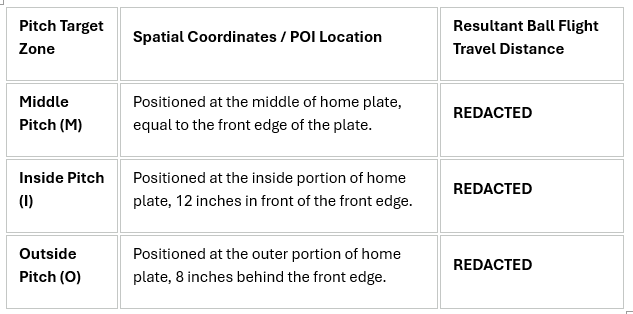
Operational Performance Metrics
Two primary data streams are captured during testing phases to measure immediate and short-term performance changes:
- Collision Geometry Deviation (CGD): Contact correctness is objectively measured using Collision Geometry Deviation (CGD), a geometry-based scoring framework developed and applied during the system-efficacy pilot. CGD evaluates whether cue-guided contact is commensurate with the intended collision target rather than relying on batted-ball result alone. Each scored contact event is assessed according to the relationship between pitch location, intended collision depth, barrel-orientation state, and spray direction. Lower CGD values indicate closer agreement between the executed collision state and the intended collision geometry. This allows the study to evaluate timing accuracy at the collision level rather than merely counting whether the batter made contact or produced a favorable outcome.
- Batted Ball Exit Velocity (EV): A launch monitor system, such as HitTrax or Rapsodo, is positioned to capture peak and average exit velocities during all initial, post-intervention, and short-term retention testing phases. EV is used as a secondary performance measure to evaluate whether reducing the timing constraint permits improved mechanical organization, collision quality, or batted-ball output.
- Collision Geometry Deviation (CGD): Contact correctness is objectively measured using Collision Geometry Deviation (CGD), a geometry-based scoring framework developed and applied during the system-efficacy pilot. CGD evaluates whether cue-guided contact is commensurate with the intended collision target rather than relying on batted-ball result alone. Each scored contact event is assessed according to the relationship between pitch location, intended collision depth, barrel-orientation state, and spray direction. Lower CGD values indicate closer agreement between the executed collision state and the intended collision geometry. This allows the study to evaluate timing accuracy at the collision level rather than merely counting whether the batter made contact or produced a favorable outcome.
Experimental Protocol Phases
- Initial Testing Phase
All three groups undergo a baseline evaluation consisting of 8 swings per round at a middle-location (M) fastball delivered at 93.6 mph. No feedback, coaching instructions, or technology-based swing signals are issued to any group during this phase. Baseline Collision Geometry Deviation (CGD) and peak/average exit velocities are cataloged for each participant.
- Practice Phase (Intervention)
Participants complete a structured training volume to evaluate rapid temporal encoding. Group 1 takes eight swings to a specified location and receives active verbal coaching alongside synchronized audio swing cues delivered by the Swing Alert System, which specifies exactly when to initiate the swing based on real-time pitch velocity over the distance of travel and the batter’s stored profile metrics. Group 2 takes the same number of swings and receives equivalent verbal coaching guidance regarding timing adjustments but receives no audio swing signals. Group 3 completes the swings with no coaching or technology assistance of any kind. There will be no formal CGD scoring or exit velocity cataloged for any group during practice trials to avoid confounding the intervention.
- Testing Phase (Post-Intervention)
All participants take two rounds of 8 swings under identical pitch location (M) and velocity parameters. Crucially, no assistance, coaching directives, or technology-delivered swing cues are issued to any group. Post-intervention CGD and exit velocities are recorded, aggregated, and averaged to measure immediate learning effects.
- Second Phase (Alternating Locations)
The protocol shifts to alternating pitch locations to test short-term spatial adaptability. Participants take rounds consisting of 6 swings total, broken down into two swings per alternating location (I, M, and O). The only external guidance provided during this phase is the explicit declaration of pitch location prior to each round. Group 1 receives audio cues during the practice blocks, Group 2 receives verbal-only coaching, and Group 3 remains unassisted. Performance testing blocks are conducted in the same manner without any assistance, where CGD and EV are formally recorded.
- Third Phase (Random Retention Analysis)
A final retention block is executed to evaluate spatial-temporal memory consolidation. Pitches are delivered at the identical 93.6 mph velocity but in a completely randomized, unpredictable location order across the three POIs. Absolutely no guidance, location declarations, or technology cues are provided to any participant. CGD and exit velocities are recorded to conduct a final spatial-temporal retention analysis.
For purposes of the present protocol, this phase evaluates short-term cue-removal retention and spatial-temporal adaptability rather than long-term memory consolidation. Long-term retention and transfer remain outside the scope of the current experimental design.
Technological Setup and Time-Domain Data Capture
Motion Capture and Bat Sensor Hardware
To derive the baseline metrics necessary to operate the automated cueing system during live practice, each participant’s bat is configured with a high-accuracy time-domain tracking device. A Micro-Electromechanical Systems (MEMS) Inertial Measurement Unit (IMU) is rigidly fixed to the knob of the participant’s bat handle. This specific knob placement is mathematically prioritized over wrist or handle placement because it directly isolates the exact orientation, swing plane, bat path, and mechanical velocity of the bat cylinder without introducing kinematic artifacts from changing hand grips.
The MEMS IMU architecture is comprised of the following interconnected mechanical components:
- Accelerometers: Measures linear acceleration profiles along the orthogonal x, y, and z axes.
- Gyroscopes: Tracks angular velocity signatures around the x, y, and z axes to map rotational mechanics.
- Magnetometers: Measures environmental magnetic fields to establish absolute spatial orientation, actively filtering out high-frequency signal noise and preventing false-positive movement triggers.
- Microcontroller: Process and integrate multi-axis sensor data, run real-time calibration routines, and output precise time-stamped kinematic data.
- Radio Signal Communication Module: Utilizes an integrated low-latency Bluetooth module to pair wirelessly with a laptop computer running the Swing Capture Software interface.
- Lithium Battery: Provides continuous, stable power to the electronic component array.
- Housing and Protection: Heavy-duty casing designed to safeguard components from impact and maintain exact structural alignment relative to the bat axis.
- Vibration Motor: An optional offset motor configuration capable of generating subtle haptic force-feedback patterns to physically prompt swing execution.
Segmentation of Temporal Variables
To calculate baseline metrics, the software issues a controlled stimulus (such as a standardized audio beep tone) which immediately initiates a high-resolution digital clock. The batter executes a swing in response to the signal, and the IMU tracks the resulting physical onset profile. The timed event completes the instant the sensor detects the structural vibration spike indicative of a bat-to-ball collision.
This tracks and calculates three distinct time-domain metrics:
- Swing Delay (SD): The elapsed time calculated by subtracting the initial cue timestamp from the first observable onset of physical movement. This encompasses both the neurobiological reaction time and any initial non-aggressive, non-positive mechanical latencies or hitches in the player’s movement signature.
- Swing Time (ST): The exact mechanical duration of the forward swing path, measured from the definitive launch point to the precise moment of bat-ball contact.
- Time to Impact (TTI): The absolute combined metric representing the total duration from initial decision/cue presentation to physical collision (TTI = SD + ST).
Multiple baseline swings are aggregated and averaged under each participant’s profile to establish their localized TTI constant for each distinct pitch location (e.g., Middle TTI = 330 ms, Outside TTI = 327 ms, Inside TTI = 338 ms).
Live Pitch Capture and Algorithmic Cue Generation
The live training environment integrates a separate pitch kinematics capture apparatus positioned directly in front of the programmable pitching machine. The device consists of a clear plexiglass tube cylinder at least 1 foot in length that houses two sequential infrared light gates spaced exactly 1 foot apart.
When a pitch is fired, the ball breaks the first infrared light gate and subsequently breaches the second light gate, capturing the Initial Velocity (IV) of the pitch. A wired microprocessor instantly calculates the time delta between the gates to capture the pitch’s IV and relays it to the tracking software.
The system’s algorithmic engine computes the execution cue execution window by executing the following real-time calculation loop:
- Velocity Drag Calibration: The algorithm maps the captured IV against the fixed flight distance to the selected POI (M: 53 ft, I: 52 ft, or O: 53 ft 8 in.). It applies an aerodynamic drag coefficient to establish the pitch’s true Average Velocity (AV) across its flight path, determining the exact arrival time of the ball.
- Temporal Synchronization: The software pulls the individual hitter’s stored average TTI data for that designated pitch location.
- Cue Delivery Execution: By correlating the pitch travel time at AV with the batter’s physical TTI constraint, the microprocessor isolates the precise millisecond window required for successful interception. When the pitch reaches this calculated threshold during flight, the system fires a deterministic audio tone to guide immediate swing initiation.
Pilot testing and error analysis verified that participants unanimously preferred this audio tone interface over haptic options, noting it was significantly more intuitive for timing synchronization. Furthermore, audio cues ensure waves of methodological transparency, as any system or event timing errors are instantly audible to research observers.
Cost of Goods (COG) and Replicability
To ensure scalability and widespread field applicability across youth, amateur, and professional sports settings, all selected hardware components—commercially available MEMS IMUs, basic infrared light gates, and standard audio speakers—were selected for maximum cost-efficiency. Minimizing the total cost of goods (COG) without sacrificing precision lowers implementation barriers, allowing researchers or teams to build multiple identical testing setups simultaneously. This cost-effective design directly supports protocol scalability and ensures testing repeatability across diverse real-world environmental settings.
Study Limitations
Sample Size and Statistical Vulnerabilities
A primary limitation of this study design is its relatively small sample size, which increases statistical susceptibility to individual outliers. In small sample sizes, unexpected data deviations caused by technical sensor glitches or anomalous participant behaviors can distort group averages, elevating the statistical risk of false positives or overestimations of observed effects. While group and individual analysis techniques are integrated to isolate these variances, future large-scale replication is required to ensure broader generalizability.
Generalizability of Time-Domain Metrics
Because this study shifts directly away from conventional swing mechanics analysis to focus explicitly on time-domain decision and initiation variables, direct comparison with traditional hitting research stands as a challenge. The observed timing signatures may primarily pertain to this specific technological capture methodology. Therefore, caution is advised when extending these conclusions to broader contexts that leverage alternative measurement designs or unstandardized pitching environments.
Participant Skill and Experience Variance
While the protocol curates a participant pool with closely aligned experience levels to minimize baseline skill discrepancies, inherent hidden mastery variations will inevitably persist. Baseball players frequently exhibit highly variable motor capabilities even within identical experience brackets. Exceptional native decision-making or movement traits could introduce skill-based outliers, requiring careful sensitivity analysis during the evaluation phase.
Environmental Variables and Technology Reliability
Conducting trials within a dynamic batting cage environment limits absolute dominion over external factors like fluctuating facility lighting, ambient background noise, and situational distractions. Lighting changes may alter a participant’s visual perception of ball flight, affecting structural accuracy. Researchers will systematically document environmental conditions during each block to mitigate this noise. Furthermore, the study remains reliant on the seamless synchronization, proper calibration, and technical performance of wireless sensors and microprocessors, meaning software or hardware latency anomalies present a persistent source of experimental uncertainty.
Training Effects, Adaptability, and Short-Term Scope
This study is explicitly designed to isolate immediate and short-term performance changes; long-term motor retention falls outside its operational scope. This study is focused on testing the immediate and short-term benefits of the cue-based errorless training system. Regular practice beyond the study duration would be necessary for long-term memory consolidation and effective skill transfer. Outside training or unmonitored practice sessions completed by participants during the course of the study could introduce an unmeasured external training effect. Additionally, initial unfamiliarity with audio cues and tracking hardware may introduce an initial learning curve, causing performance fluctuations early in the data collection process.
Accordingly, claims from the present protocol should be limited to immediate acquisition, short-term cue-removal performance, and short-term randomized-location retention. Long-term consolidation, competitive transfer, and durability across extended time intervals should be treated as future research questions rather than conclusions of this study.
Results
(Data, metric charts, and statistical evaluation tables to be populated immediately upon execution of experimental protocols and final testing compilation.)
References
- Maguire, E. A., & Woollett, K. (2011). Acquiring ‘‘the Knowledge’’ of London’s Layout Drives Structural Brain Changes. Current Biology, 20(24), 2109-2114.
- Francisco Alonso et al. (2023). Effectiveness of Driving Simulators for Drivers Training: A Systematic Review. MDPI (Directory of Open Access Journals – DOAJ).
- Bailey, C. H., Kandel, E. R., & Harris, K. M. (2015). Synaptic Consolidation of Memory: A Synthesis of Research from Molecular to System Level. Neuron, 88(1), 17-36.
- McClelland, J. L., McNaughton, B. L., & O’Reilly, R. C. (1995). Why there are complementary learning systems in the hippocampus and neocortex: insights from the successes and failures of connectionist models of learning and memory. Psychological Review, 102(3), 419-457.
- Davis, B., & Francis, K. (2020). “Errorless Learning” in Discourses on Learning in Education. Frontiers in Education, Hypothesis and Theory, Article 760867. doi: 10.3389/feduc.2021.760867.
- Chase, W. G., & Simon, H. A. (1973). Perception in chess. Cognitive Psychology, 4(1), 55–81. https://doi.org/10.1016/0010-0285(73)90004-2.
- Williams, A. M., Ford, P. R., Eccles, D. W., & Ward, P. (2012). Perceptual-cognitive expertise in sport and its acquisition: Implications for applied cognitive psychology. Applied Cognitive Psychology, 26(3), 344-349. https://doi.org/10.1002/acp.1810.
- Maxwell, J. P., Masters, R. S. W., Kerr, E., & Weedon, E. (2010). The implicit benefit of learning without errors. Quarterly Journal of Experimental Psychology, 63(9), 1657-1672.
- Chen, L., & Lee, M. (2019). Reducing Errors in Basketball Shooting through Cueing. Journal of Sports Psychology, 45(2), 120-135.
- Piek, J., Pitcher, T., & Hay, D. (1999). Effects of Visual Cue Training on a Complex Gross Motor Task in Children with Developmental Coordination Disorder. Physical Therapy, 79(10), 949-958.
- Maxwell, J. P., Masters, R. S. W., Kerr, E., & Weedon, E. (2000). The implicit benefit of learning without errors. The Quarterly Journal of Experimental Psychology, 53A(4), 1059-1080. https://doi.org/10.1080/027249800410535.
- de Winter, J., Bazilinskyy, P., & Petermeijer, B. (2015). Use of auditory interfaces for takeover requests in highly automated driving: A proposed driving simulators study.
- Guimarães, A. N., Ugrinowitsch, H., Dascal, J. B., Porto, A. B., & Okazaki, V. H. A. (2020). Freezing Degrees of Freedom During Motor Learning: A Systematic Review. Motor Control, 24(3), 457-471. doi: 10.1123/mc.2019-0060.
- Baddeley, A., & Wilson, B. A. (1994). When implicit learning fails: amnesia and the problem of error elimination. Neuropsychologia, 32(1), 53-68. doi: 10.1016/0028-3932(94)90068-x.
- Buneo, C. A., & Andersen, R. A. (2006). The posterior parietal cortex: Sensorimotor interface for the planning and online control of visually guided movements. Neuropsychologia, 44(13), 2594-2606. doi: 10.1016/j.neuropsychologia.2005.10.011.
- Eichenbaum, H. (2017). The role of the hippocampus in navigation is memory. Journal of Neurophysiology, 117(4), 1785-1796. doi: 10.1152/jn.00005.2017.
- Cohen, Y. E., & Andersen, R. A. (2002). A common reference frame for movement plans in the posterior parietal cortex. Nature Reviews Neuroscience, 3(7), 553-562. doi: 10.1038/nrn873.
- Andersen, R. A., & Cui, H. (2009). Intention, action planning, and decision making in parietal-frontal circuits. Neuron, 63(5), 568-583. doi: 10.1016/j.neuron.2009.08.028.
- Wolpert, D. M., Ghahramani, Z., & Jordan, M. I. (1995). An internal model for sensorimotor integration. Science, 269(5232), 1880-1882. doi: 10.1126/science.7569931.
- Körding, K. P., & Wolpert, D. M. (2004). Bayesian integration in sensorimotor learning. Nature, 427(6971), 244-247. doi: 10.1038/nature02169.