
Analysis of a Toddler and the Governing Mechanism of Hitting
By Ken Cherryhomes ©2026
A Real-World Example
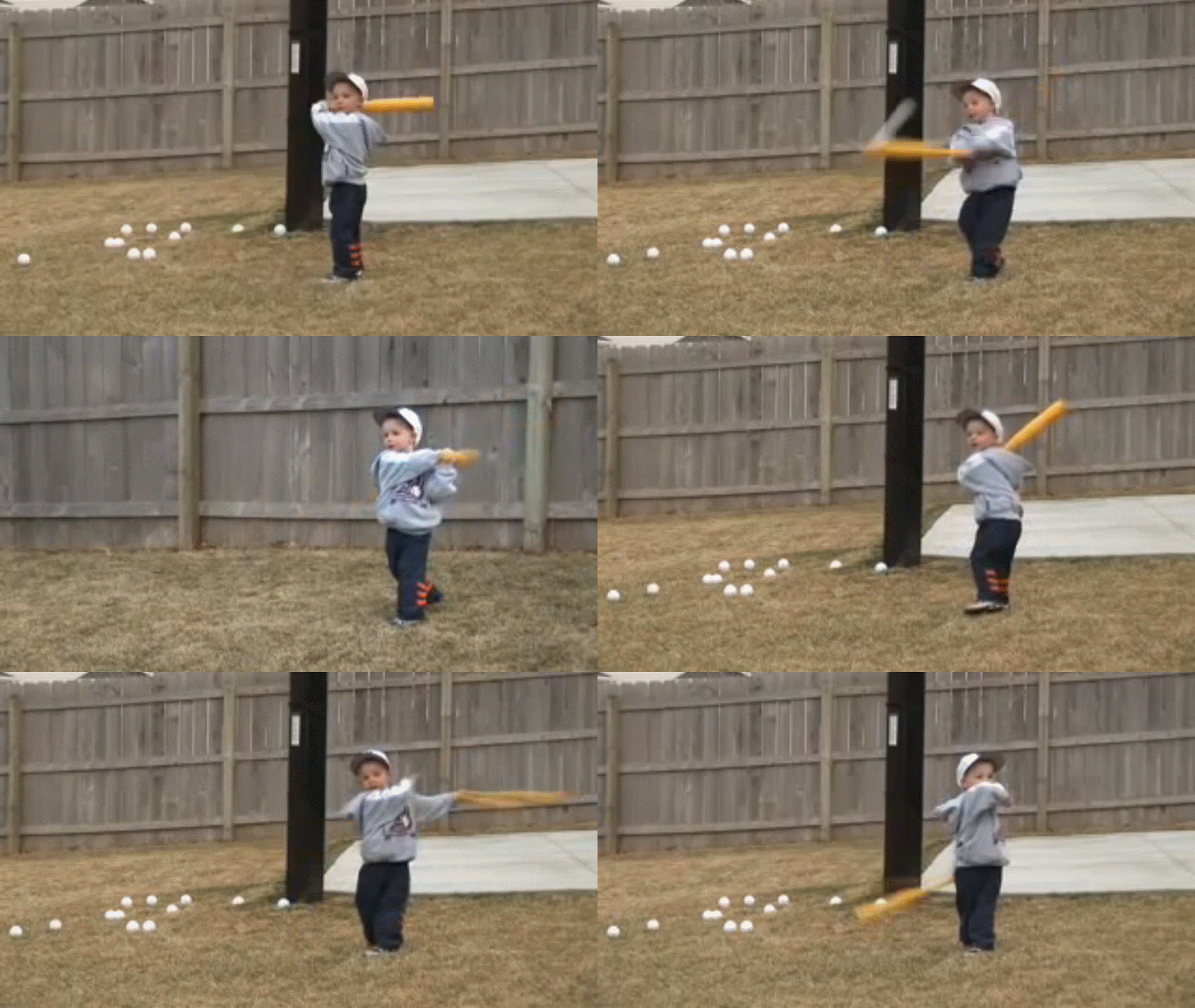
The Problem
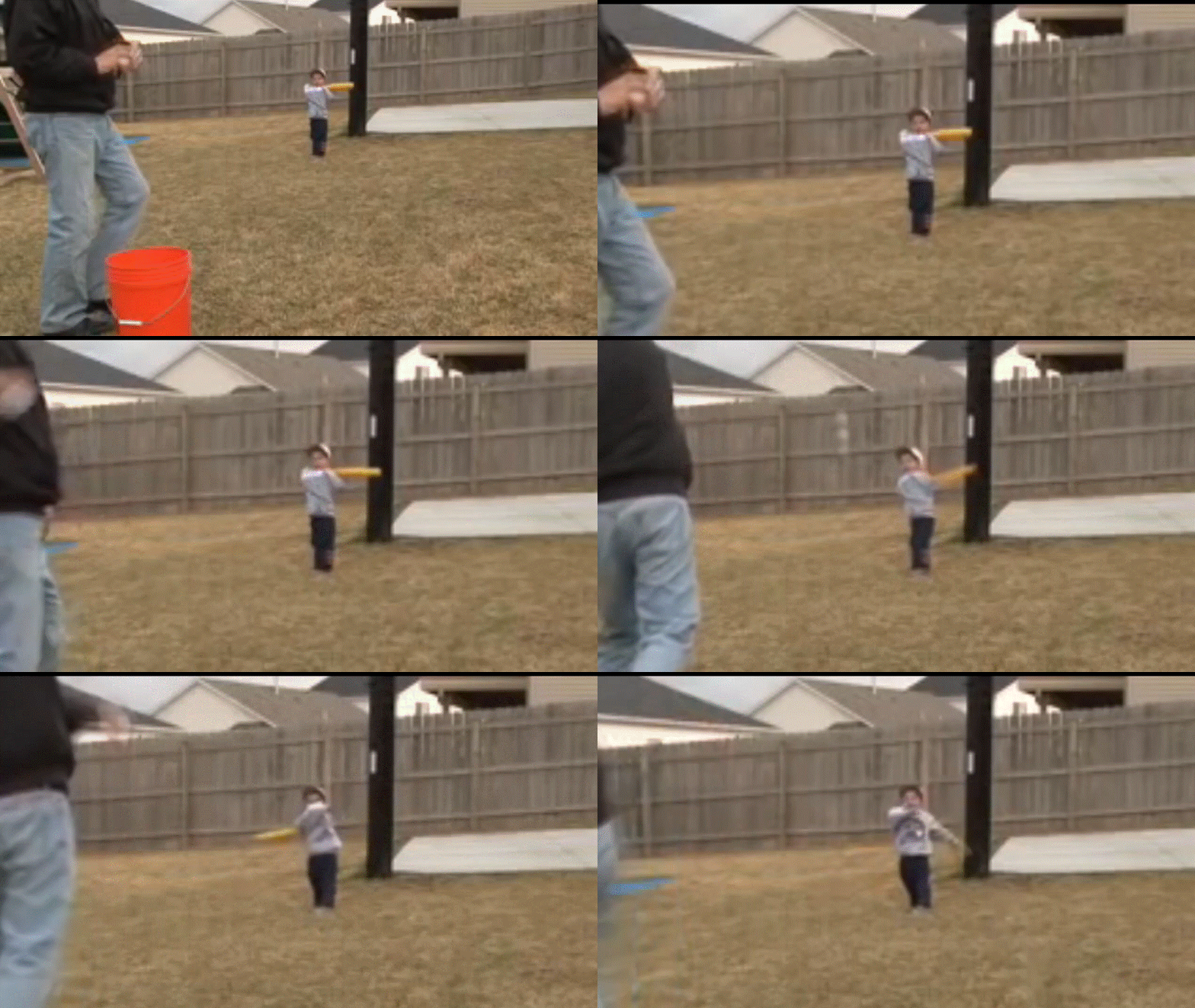
The problem confronting the toddler is far from trivial. The pitcher is an adult, so the ball is released from a height well above the child’s strike zone and thrown firmly rather than lobbed. The pitch therefore travels on a steep descending trajectory, changing vertical position continuously from release to arrival while its velocity also changes in flight. To strike it, the child must predict where that moving ball will enter his collision space, access the corresponding solution within his internal map, and synchronize it with the time required for his own bat to accelerate to that point. He is effectively resolving two changing motions at once: a pitch losing speed as it approaches and a bat gaining speed after launch. The resulting path is neither an exaggerated upward loop nor a downward chop. It is a direct, efficient route organized toward the selected collision, including the depth of contact, the orientation of the barrel, and the portion of the ball required to produce the intended flight. None of this is available to him as technical knowledge. Yet the solution appears in the movement. That is what makes the example remarkable.
Intent, Proprioceptive temporal-spatial Swing Mapping, and Spray Directional Control
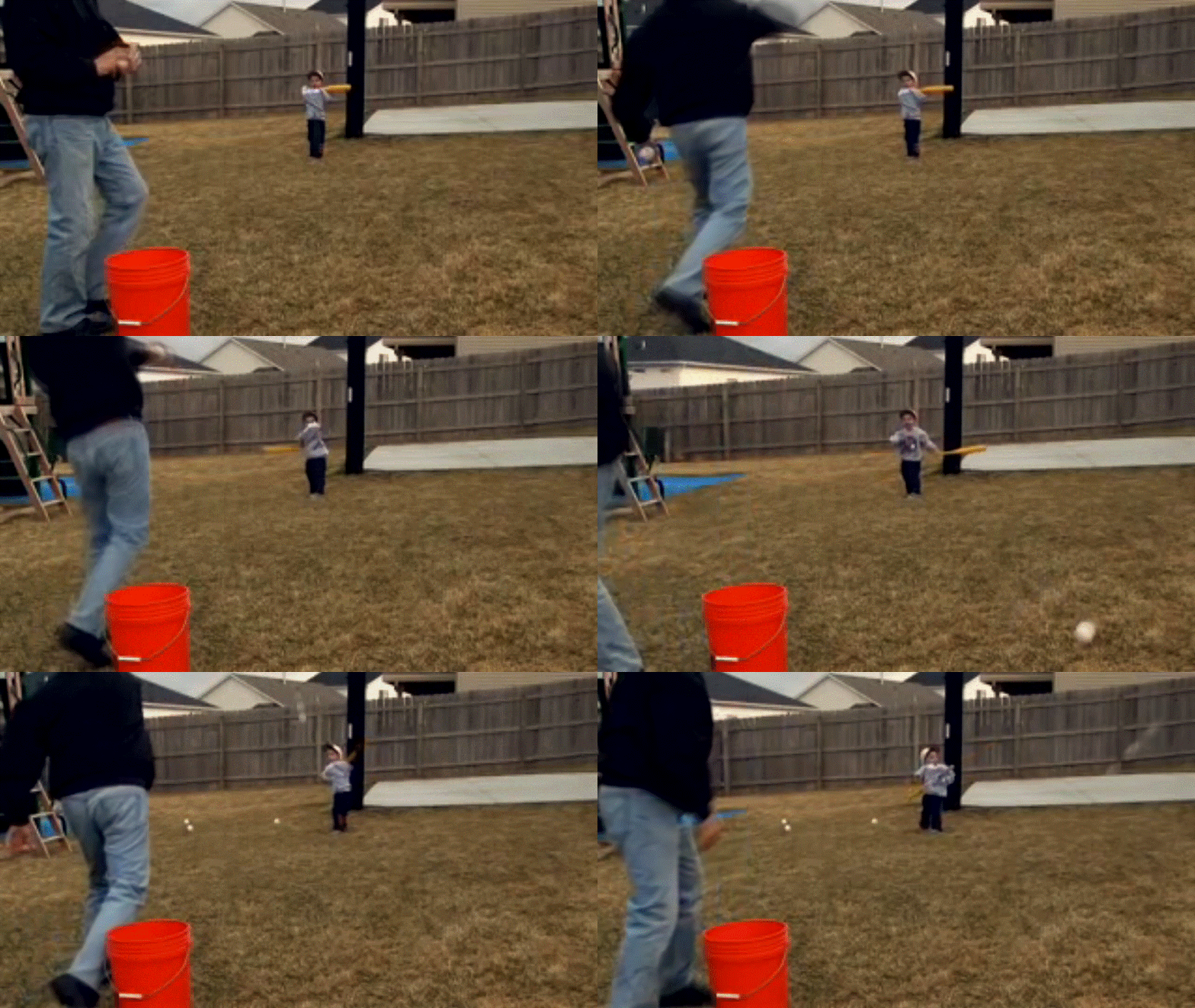
Here we see the application of intent and directional control. On the first swing, the pitch is over the middle, and the child lifts it on an upward line-drive trajectory. On the second, the pitch is thrown inside. The same underlying movement solution governs both actions, but the location requires a different collision depth, barrel orientation, and spray direction. That adjustment was not created in the moment. Through prior attempts, the child had already solved collisions at both locations and internalized the corresponding relationships within a learned proprioceptive, temporal-spatial collision map. The inside pitch therefore accessed a different stored solution within the same motor organization.
Plane Matching
Next, we see plane matching emerge as a micro-adjustment within the same underlying movement solution. Traditional swing instruction often treats plane matching as the governing shape of the swing, describing the objective as matching the descending trajectory of the pitch to remain on plane longer. This example suggests something different.
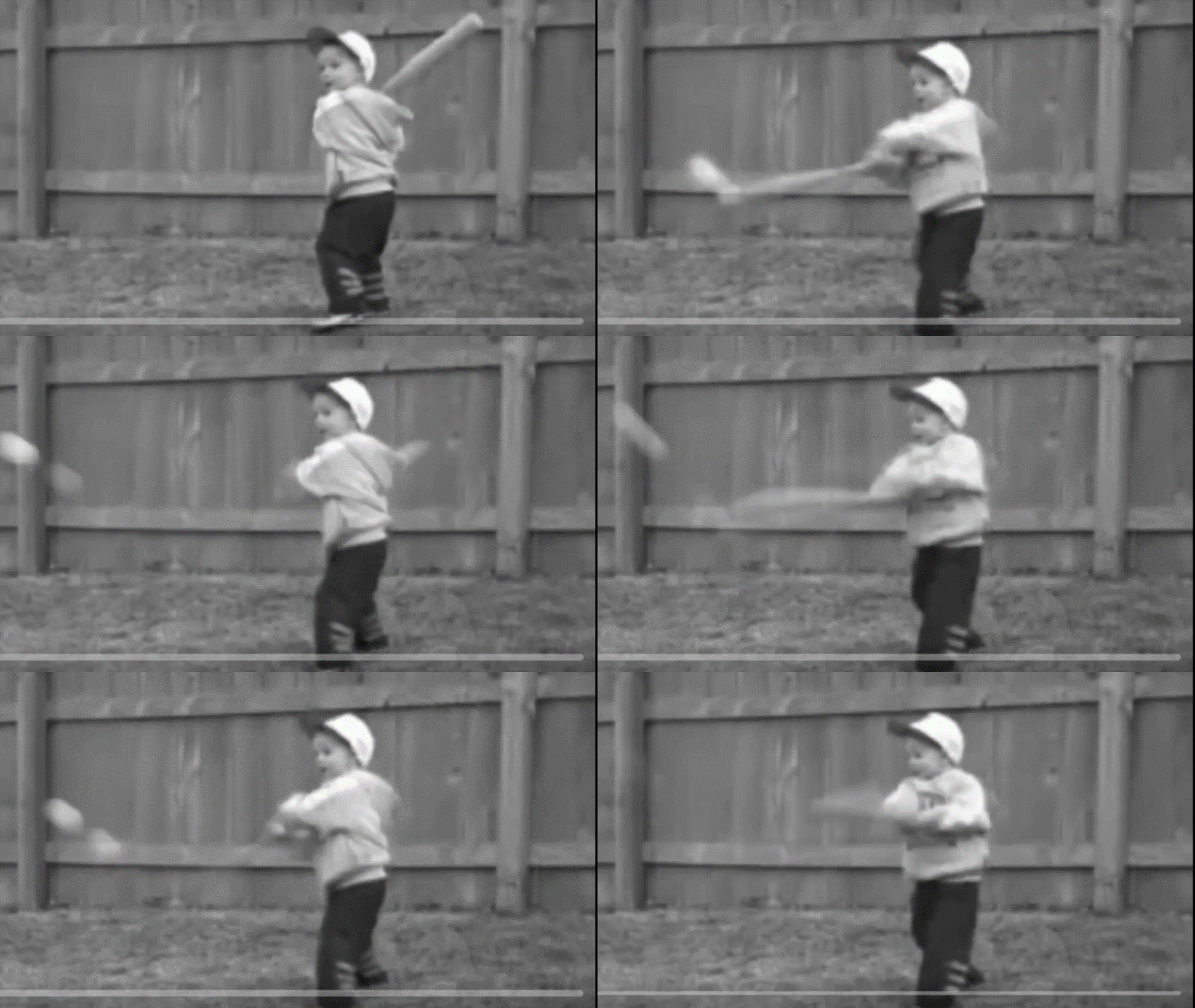
In this GIF, scrubbed back and forth through the final approach to collision, the child’s broader swing path can be seen taking a direct and efficient route to the predicted collision point rather than tracing the pitch’s descending trajectory. Near the ball, however, the barrel makes a smaller adjustment in plane and orientation. That localized change positions the bat to strike the ball to produce the intended lift trajectory. What the GIF reveals is not an entire swing organized around staying on the pitch plane, but a precise proprioceptive adjustment applied near collision in service of the desired ball flight.
That adjustment rests on several layers of learning already present in the child’s movement. Reach-and-grasp organization provides the efficient route to the collision point. Experience supplies the timing and encoded collision map required to arrive at the correct depth and moment. Observation supplies the model for the desired ball flight, the manifestation of his intent. Those elements converge near collision through the application of that intent and precise proprioceptive control. None of this was learned through deliberate instruction, yet the complexity of the resulting solution is extraordinary.
When Constraints Intensify
Imagine that the toddler continues to hit. He dominates coach pitch and then early kid pitch, his swing remaining largely recognizable while the proprioceptive, temporal-spatial map beneath it becomes richer and more precise. He learns additional speeds, locations, collision depths, and ways to direct the ball. By the time he enters his 12U season, many consider him a prodigy.
Then the demands intensify. The pitching is faster. Release points vary more. Pitchers now command breaking balls rather than merely throwing them. The collision physics remain unchanged. The bat and ball must still arrive at compatible locations, orientations, and times. What changes is the difficulty of perceiving, predicting, and timing that collision. He must identify pitch type, resolve movement, estimate location, and access the appropriate collision solution under greater uncertainty and with less time.
If his performance now declines, logic requires us to begin with what actually changed. The hitter did not suddenly become a different mover. The environment became more difficult than anything his perceptual and temporal system had previously calibrated against. He becomes confounded, and the movement may regress visibly as a result.
That regression does not mean the mechanics independently failed and then caused the hitting failure. Such an explanation leaves the supposed mechanical breakdown itself unexplained. The hitter is still attempting to create collisions at the same encoded points within his proprioceptive, temporal-spatial map because the collision physics remain constant. What has become unresolved is the mathematics required to reach those points under greater velocity, movement, and deception.
The required collision point still exists within the map. What has changed is the hitter’s ability to predict where and when the ball will arrive there with enough certainty and enough time to launch the corresponding movement solution. His estimates of trajectory, location, and arrival time are now less reliable, while the interval available to organize the swing has narrowed. He is still trying to reach the same encoded collision points, but the temporal and spatial problem no longer resolves cleanly.
The body responds by making whatever compensations are available to preserve contact. The swing may shorten, stiffen, rush, lose rotation, or otherwise reduce movement variables. Those changes do not show that the map or the underlying motor solution has disappeared. They show the hitter attempting to force an unresolved calculation into a familiar collision framework. What appears to be a mechanical defect is the visible consequence of a perceptual and timing problem the hitter has not yet learned to solve.
This is usually the point at which a parent consults a hitting coach. The hitter is no longer producing reliable results, and the movement now visible to the coach appears increasingly untenable against the level of pitching he is facing.
The first-principles question is not whether the swing looks different from an ideal model. It is what changed in the hitter’s environment that could have produced the movement now being observed. The answer is already present in the developmental sequence. The hitter had successfully expressed the same underlying solution for years. Only when the demands of the environment exceeded the range of problems he had previously learned to resolve did the movement begin to deteriorate.
Without examining that causal sequence, the visible mechanics are treated as the problem itself. In line with tradition, the hitter is compared against a consensus mechanical blueprint, and a new swing plan is created. Positions are changed, movement patterns are replaced, and the action is reorganized around an externally prescribed model.
The Same Causal Error at Every Level
This is where the developmental example meets the argument of my previous paper. The toddler did not need an attack-angle measurement, a prescribed swing path, or a mechanical explanation of how to lift the ball. He learned to produce the intended flight through experience, observation, proprioceptive control, and repeated attempts to solve the collision. The resulting barrel path and orientation emerged in service of intent.
That evidence is important to recognize because many qualities later treated as mechanical objectives were already present before the hitter could understand them as instructions:
- swing path
- barrel orientation
- collision depth
- directional control
They did not first appear as positions imposed from the outside. They emerged as parts of a coordinated solution to a task the child was trying to accomplish.
The same expressions are later measured, assigned preferred values, and reverse-engineered into mechanical prescriptions. Attack angle is converted from a description of the bat during a particular collision into a path the hitter is instructed to reproduce. Ball-flight outcomes are traced backward into body positions and barrel states, then applied as retrofits to hitters whose movement systems had already learned to create those outcomes adaptively when the spatiotemporal collision constraints were resolved. My previous paper argued that this turns context-dependent expressions into standing mechanical orders and risks diminishing the adaptability that made the swing successful.
The young hitter provides unusually clear evidence of the distinction. Intent can organize the action toward a desired result without the hitter possessing technical knowledge of the movement that produces it. As collision depth, pitch location, and desired ball flight change, the path and barrel state can change with them. Their value does not lie in conforming to a preferred number independently of the task. Their value lies in how effectively they serve the collision being attempted.
I am compelled to repeat, this does not make biomechanics unimportant. Both the toddler and the professional hitter can benefit from biomechanical intervention that improves:
- sequencing
- movement efficiency
- force transfer
- physical capacity
- bat speed
That’s optimization within an existing swing, not replacement of the swing itself.
A hitter’s swing is one of the most personal, familiar, and deeply encoded actions they possess. No one knows the hitter’s body, its capacities, limitations, and necessary compensations better than the hitter’s own subconscious mind, which has spent years organizing it around the task. That swing has been built through years of adaptive learning. Some of its individual features may not resemble an idealized model, yet they may be essential to how that hitter creates a functional and repeatable solution.
Our toddler makes the thesis from the previous paper observable. Before he could understand hitting in technical terms, he had already organized a complex and adaptable swing solution. It emerged through experience and subconscious problem-solving before formal instruction was possible. This provided a relatable, visible example of how intelligent movement could develop before the hitter could explain how it worked.
The question is not whether a swing can be measured or improved. It is whether the measurement describes the movement, explains why it changed, or justifies replacing the solution that produced it. The toddler’s swing makes that distinction difficult to ignore.