
Swing-Timing Guidance Under Variable Pitch Location: Inside-First Calibration and Randomized Sequence Validation Testing
By Ken Cherryhomes ©2026
The X Factor Hitting System was evaluated in pilot testing conducted across three multi-round sessions spanning six weeks and involving six hitters serving as system operators. Read complete study here: X Factor Research System Efficacy and Validation – X Factor Technology Live machine-pitched baseballs were delivered between 90-92mph under controlled conditions while the system measured pitch kinematics, referenced each hitter’s captured and stored Time to Impact profile, and computed a precisely timed swing-initiation cue for a predetermined collision target. The testing was designed to determine whether the system’s algorithms could provide usable real-time timing guidance and whether resulting collisions remained commensurate with the intended contact depth, barrel orientation, and directional geometry as pitch-location demands changed.
The progression of pitch locations across the three sessions was deliberate. The first session emphasized middle-location pitches because they provided the greatest familiarity and comfort for the hitters while they adapted to using an externally supplied timing cue rather than relying entirely on established internal timing priors.
Swing cue and batter response
Swing cue and batter response
The second session expanded testing to inside and outside locations, allowing the stored hitter profiles, collision-point matrix, and reduced-recalibration pathway to be evaluated as the required interception point changed across the hitting zone.
Outside to inside testing
The final session was structured around a more specific timing principle. It was intentionally dominated by inside pitches because the inside location imposes the earliest response requirement on the hitter. To intercept the ball at the intended collision point, the hitter must begin the response sooner than he would for a comparable middle or outside pitch. The inside pitch therefore represents the most constrained timing demand within the pitch event.
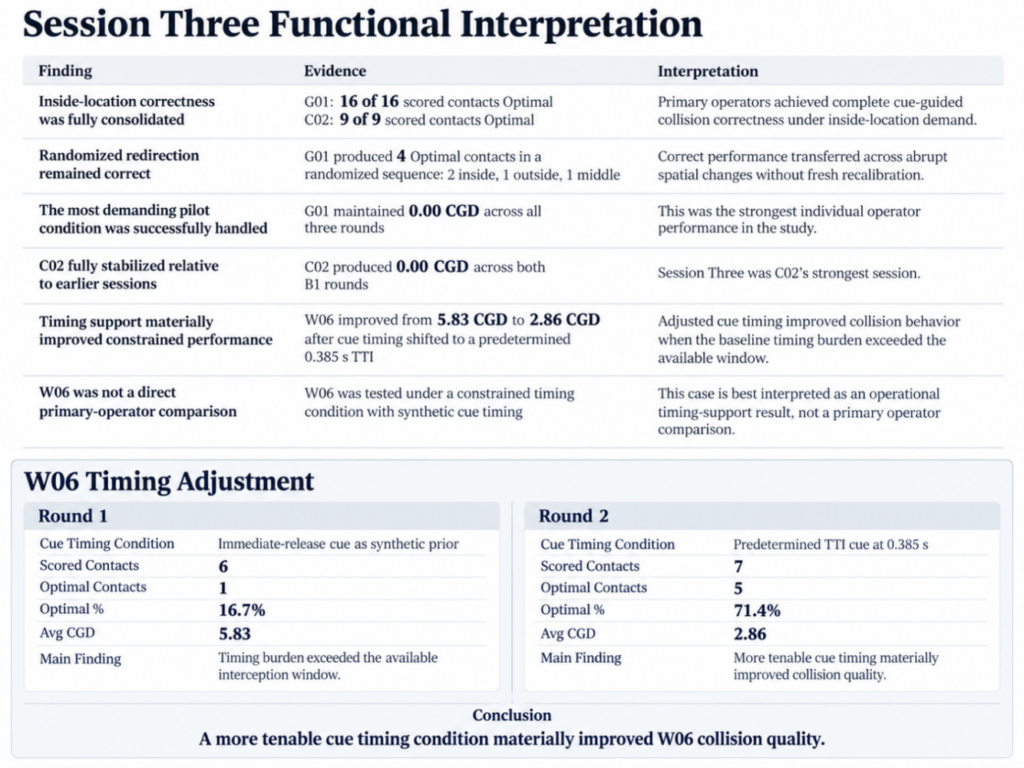
Session Three Round Two – 8 swings 90-92mph (one errant pitch #7)
Session Three Round Two – C02-031
That distinction shaped the training logic used in the test. If the hitter prepares for the pitch requiring the earliest response, he has created enough time to meet the most constrained timing demand. If the pitch instead arrives middle or outside, the hitter can give time back by delaying initiation. The reverse is not equally available. A hitter who prepares for a later-response condition cannot recover time that has already elapsed when an inside pitch requires an earlier response.
This approach runs counter to a common traditional hitting strategy, particularly in two-strike situations, in which hitters are taught to look away or off-speed and react to the inside pitch. In my work with professional hitters, I retrained that timing priority by teaching preparation for the earliest-response demand. With non-professional hitters, that priority was established from the outset so the traditional outside-first timing habit did not first have to be learned and later reversed.
The inside-pitch emphasis in the final session therefore served a purpose beyond simply testing another pitch location. Repeated inside pitches were used to establish and reinforce the attentional and temporal state associated with the earliest-response condition. The hitter was being prepared to organize the event around the pitch with the most constrained timing demand.
The final four-pitch round was then constructed to determine whether the hitter would continue to follow the system-issued cue once that inside-pitch timing prior had been reinforced. The sequence was randomized only from the hitter’s perspective. Its construction was intentional. The first two pitches were inside pitches, specifically to calibrate the hitter’s attention and strengthen the recently established timing prior associated with the earliest-response condition. The remaining pitches then changed to middle and outside locations without the hitter knowing the sequence in advance.
Random 4-pitch sequence 90-92mph
The critical question was whether the hitter would continue to respond to the deterministic cue as the required timing changed, or whether he would override the cue and rely on the inside-pitch timing prior that had just been reinforced. If the established prior dominated, the later-location pitches should have exposed that conflict through premature initiation and degraded collision geometry.
Instead, all four contacts in the randomized sequence were graded Optimal. Within the scope of the pilot testing, the result indicated that the hitter continued to use the system-issued timing cue rather than simply carrying the reinforced inside-pitch prior across changing pitch locations.
The randomized sequence therefore tested more than location switching. It examined whether deterministic cueing could remain behaviorally operative when it conflicted with an immediately reinforced internal timing expectation. The result supported the timing rationale used to structure the final session: prepare the hitter around the most constrained timing demand, then determine whether the system cue can still govern the precise timing adjustment required when the pitch affords more time.
Same Swing, Different Timing
The final observation from the testing is also the simplest. Different pitch locations did not require the hitter to manufacture different swings. They required different timing.
Tony Gwynn described this in practical hitting terms. The swing itself could remain fundamentally the same while pitch location changed where along that swing the ball was intercepted. An inside pitch had to be met earlier and farther forward, producing a more pull-side spray direction. A middle pitch was intercepted later, and an outside pitch later still, allowing the same swing to produce progressively different directional outcomes.
Tony Gwynn on all fields hitting approach
The hitter shown here demonstrates that principle directly. Across the three locations, the visible change is not a wholesale mechanical reorganization of the swing. The critical change is when the barrel arrives relative to the ball. By changing collision timing, the hitter changes collision depth, barrel orientation at impact, and therefore outgoing spray direction.
Identical swing mechanics timed to different locations.
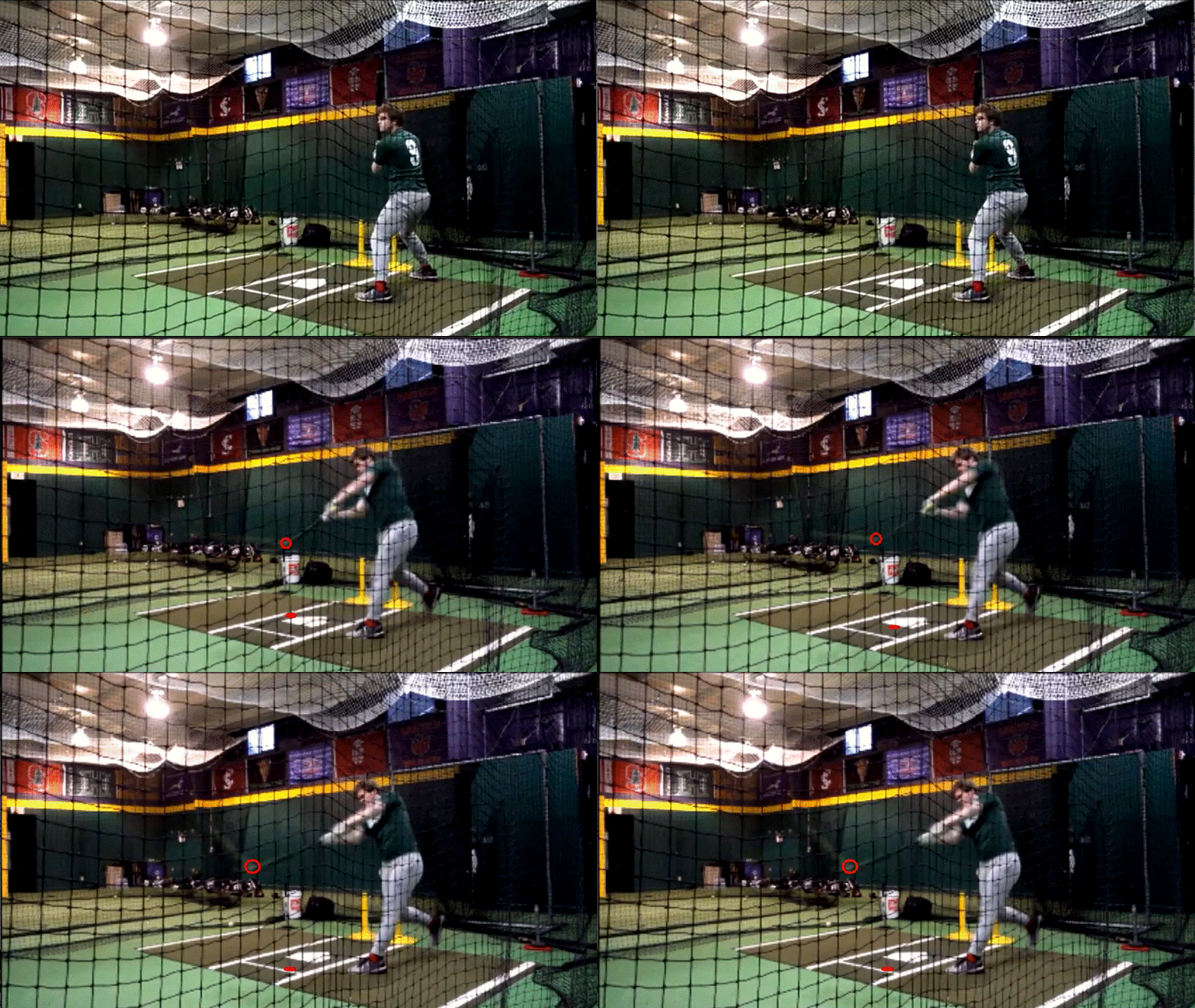
That is the practical significance of the X Factor Hitting System. It does not need to prescribe a different swing for every pitch location. It solves when the existing swing must arrive. The same swing can then produce different, location-appropriate collision outcomes because timing determines where along the swing arc contact occurs.