
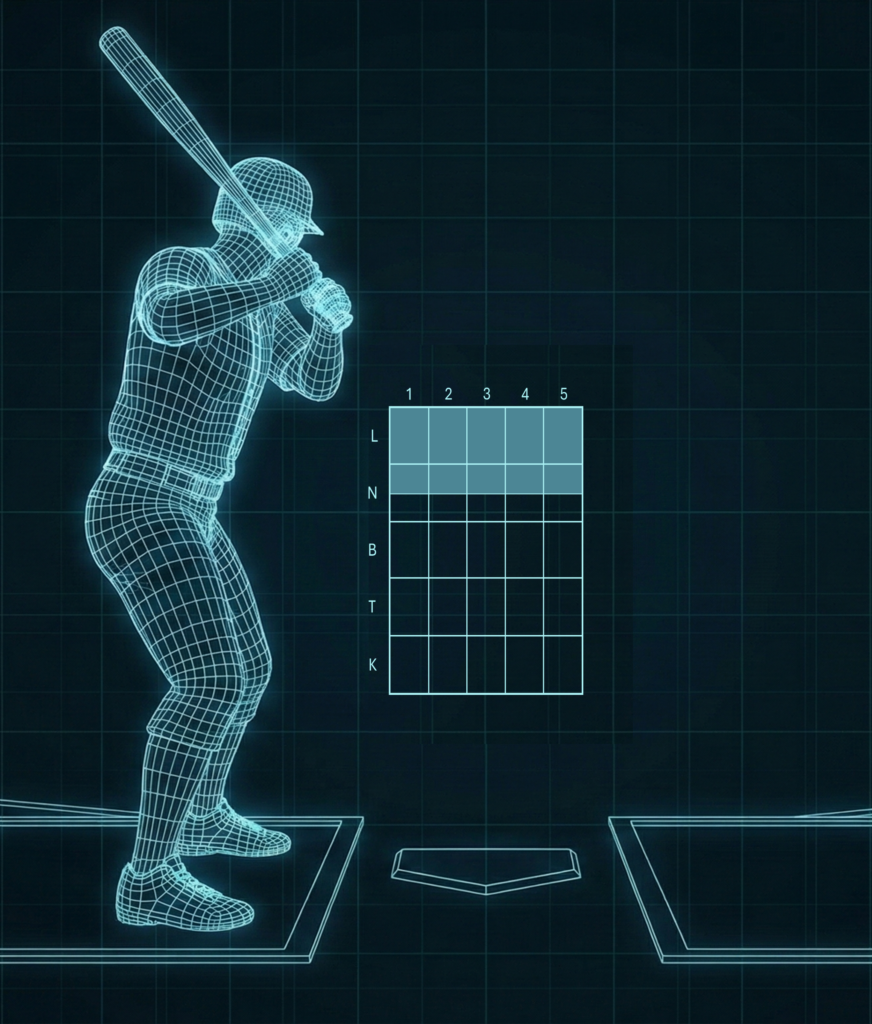
Internal Swing Timing Maps and the New 2026 ABS Height-Adjusted Strike Zone
By Ken Cherryhomes ©2026
The implementation of the 2026 ABS height-adjusted strike zone may change more than strike calls. It may also lead analytics to penalize hitters for reasons unrelated to plate discipline or decision-making. The primary issue is the persistence of previously productive upper-zone collision solutions. Swings at pitches now classified as chase do not necessarily reflect the same kind of error for every hitter. In many cases, they reflect the preservation of timing and collision models built under prior perceptual, reinforcement, and rule-based conditions, including upper-zone collision states that had been consolidated as damage-capable.
Proprioceptive Internal Swing Mapping
These solutions are not stored as abstract reactions or isolated timing references. Rather, they exist as anticipated collision states that include where and when contact can occur, as well as what wrist/hand and barrel orientation must be present when it does. The batter does not perceive timing in isolation. Every swing decision is formed through coupled information and internal references.
This internally referenced model is what I call proprioceptive internal swing mapping. It refers to the batter’s internally encoded spatiotemporal model of the swing as it relates to anticipated pitch arrival. It’s not limited to a sequence of movements. It’s an organized map of future collision states coupled to predicted ball states. Within this map, visual information and stored pitch references function as Bayesian priors, allowing the hitter to anticipate and then predict where and when the ball will arrive. But those priors are not merely temporal. They are multi-faceted, consolidated memories in which time, space, proprioceptive reference, contact depth, and barrel orientation are coupled and cross-confirming.
The Integrated Functional Structure
The internal map organizes the relationship between the predicted arrival of the ball and the availability of a corresponding collision state. It is a predictive intercept map, not merely a timing map, because it organizes when and where ball and bat can meet under the correct temporal and geometric conditions. At the same time, it organizes where the barrel will be, when it will arrive there, and in what orientation it will arrive relative to the incoming pitch. In that sense, it is also a contact-depth map and a barrel-orientation map. These are not separate functions. They belong to the same integrated functional structure, because timing in hitting has no real meaning apart from the collision state timing is meant to deliver.
This point matters because what is being encoded is not just swing initiation, but the timed availability of specific collision states within the swing. The internal map therefore functions as a running inventory of when distinct contact solutions become accessible relative to the incoming pitch.

The hitter doesn’t simply learn when to start. They learn when particular collision states within the practiced, automatic swing become available in relation to the incoming pitch. For any point in the swing arc, the internal map includes the temporal relationship between launch and arrival, the depth at which contact would occur relative to the body, and the barrel orientation that would exist at that moment. What’s being internally modeled, then, isn’t generic movement, nor is a new swing solution being created each time.
What’s being internally modeled is the availability of specific collision states within an already practiced movement pattern, so those states can be matched to the demands of the live pitch. The body is not relearning the swing with each pitch. It is learning which available collision state can solve the intercept problem, when that state will be available, where contact can occur, and what the bat’s spatial condition will be when it does.
In cognitive terms, this is why the live intercept problem cannot be reduced to automatic execution alone. Although the practiced swing may operate automatically in its mechanics, consistent with what Kahneman described as System 1, the timing decision remains conscious and perception-driven, consistent with System 2. That decision, however, can be accelerated when live visual information aligns closely with previously consolidated Bayesian priors. The pitch is not met by reflex, nor by slow conscious construction. It is met through rapid conscious evaluation in which current perceptual input is matched against coupled, consolidated predictive references linking pitch expectation to the proprioceptive and orientational collision states already available within the practiced swing.
What people often call adjustability can be understood more precisely as an instantaneous, subconscious recalculation that occurs when the hitter’s initial intercept prediction proves incorrect. When updated pitch information reveals that the original launch timing or projected collision state was off, the hitter does not abandon the internal map and construct an entirely new solution. The same spatiotemporal reference structure still governs the task. The hitter is still attempting to satisfy the same anticipated collision state, including the same intended contact depth and barrel orientation encoded in the internal map. What changes is the timing and movement pattern used in the attempt to get there. The altered swing, then, is not evidence of a new objective, but of a rapid recalculation made in service of the same internally referenced interception state.

Seen that way, adjustability strengthens the argument for proprioceptive internal swing mapping. If the hitter were merely reacting without a stable internal reference, there would be no coherent target for the recalculation to preserve. But when the swing reorganizes after a mistimed launch or an updated pitch estimate, what remains constant is the underlying intercept blueprint. The hitter is still referencing the same coupled spatiotemporal solution, even if the visible pattern of movement now looks dramatically different. In that sense, the altered swing is not random compensation or improvisation detached from memory. It is constrained reorganization guided by a multi-faceted internal map whose temporal, spatial, proprioceptive, and orientational elements remain coupled and cross-confirming even under changed conditions.
What matters here is causal order. Contact depth and barrel orientation are not details appended after timing has already been solved. They are part of what timing is solving for. A hitter is not first solving a generic when and only afterward attaching a spatial answer to it. The timing decision is meaningful only because it is organized around a predicted collision state. That means the internal map does not treat time, contact depth, and barrel orientation as separate pieces of information. It binds them into a single intercept problem. To speak of timing apart from those collision properties is to strip timing of its actual function in hitting. Timing, in the operative sense, is the organization of access to collision states.
Within that framework, the new 2026 height-adjusted strike zone becomes important because it may expose the persistence of previously consolidated internal maps. If the legal vertical boundaries change, hitters don’t instantly stop offering at pitches that now sit above the new upper boundary. They may continue to swing there because their proprioceptive timing-depth-orientation maps were built under prior perceptual and reinforcement conditions. In other words, the internal map still contains upper-zone intercept solutions that had already been learned, stabilized, and stored to memory.
That point matters most around the hitter’s letters. We may see chase-rate increases, or at minimum persistent chase behavior, on pitches above the new upper boundary precisely because those pitch categories may still live inside the hitter’s consolidated internal map. If that happens, it shouldn’t automatically be reduced to poor plate discipline or conscious over-aggression. It may instead reflect the persistence of a sensorimotor reference structure that still classifies those upper pitches as actionable because the timing, contact-depth, and barrel-orientation solutions for them had already been reinforced through repetition.
This becomes even more important when swing path is considered. For hitters with more direct swing paths, upper-zone pitches, particularly from the middle of the zone across to the outer third, can be premium collision opportunities. Those pitches are ideal when met with proper timing because the contact geometry can be highly favorable. They can be hit harder and carry farther, and the barrel’s vertical angle at collision can support more direct backspin potential.
The hitter may therefore continue to offer at those pitches not merely because they were once called strikes, but because they may have been deeply consolidated as high-value offensive solutions. The internal map doesn’t simply preserve a history of what had to be defended. It may preserve a history of what could be damaged.
If a hitter repeatedly experienced letter-high pitches from middle to outer-third as favorable collision opportunities, then the timing, contact depth, and barrel orientation associated with those pitches may be especially durable in memory. In that sense, chase-rate metrics may unjustly penalize some hitters, not only because the legal strike zone has changed relative to the maps they previously consolidated, but also because the pitches now classified as chase may overlap with regions that historically offered real offensive value for that hitter.
That creates a lag between rule change and embodied recalibration. The legal environment can change immediately. The hitter’s internal map does not. Previously reinforced priors do not disappear the moment the strike zone is redefined, especially when those priors were built not only around what had to be protected, but around pitches that may have offered real offensive value. Until repeated non-reinforcement, changed consequences, and altered decision payoffs begin to reorganize the map, the hitter may continue to execute collision solutions that remain coherent within their internal system even though they no longer align with the updated strike definition.
Swings above the new upper boundary should not automatically be treated as equivalent expressions of poor plate discipline. Some may reflect maladaptive persistence that now works against the hitter. Others may reflect the continued retrieval of previously rational, deeply consolidated, and in some cases historically productive upper-zone solutions. The analytic task is not simply to count those swings as generalized chase events, but to determine what kind of chase they represent and what sensorimotor history they reflect. Raw chase-rate metrics can describe the outcome category. They cannot, by themselves, explain the causative context that produced it.