
What a Shorter Bat Swing Arc Buys You and What It May Cost
By Ken Cherryhomes ©2026
Today, there is an emphasis on “letting the ball get deep,” but that phrase has become an interpretation more than a precise description of what hitters actually need to do. Coaches have used it for years as a way to keep hitters from pulling pitches they should handle to the middle or opposite field, especially pitches away. The problem comes when deep gets turned into a universal contact goal. It shouldn’t be. An outside pitch is naturally intercepted deeper because of where the barrel meets it in the swing, while an inside pitch has to be caught farther out front. If the hitter is trying to create loft, a more forward collision point is often advantageous as well. Contact depth is therefore not a fixed ideal. It changes with pitch location, intended ball flight, and the collision geometry required to produce that result. The velocity argument adds another layer, because allowing the ball to travel farther does buy time, but the amount of time gained, and the tradeoffs required to get it are often overstated.
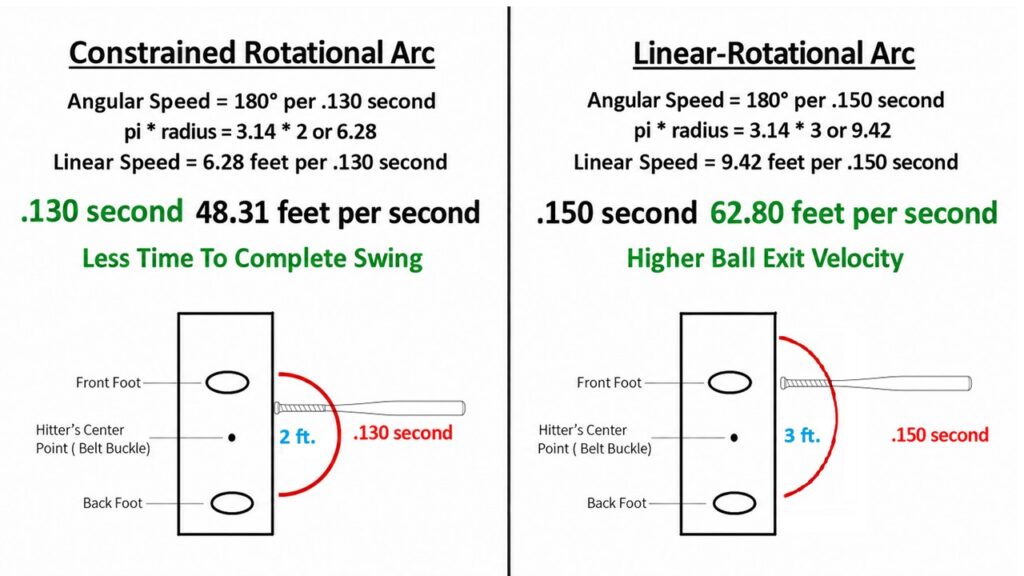
In the comparison image, both swings begin with the hands working in essentially the same direction: forward toward the incoming pitch. The difference is what happens after that initial move. In the constrained rotational arc, the barrel begins turning around the hitter sooner, which shortens the total trip of the barrel. In the linear-rotational arc, the hands continue working forward longer while the barrel keeps turning, so the barrel travels farther before collision. The rounded arcs in the image are schematic. The point is not the exact shape of the path, but the difference in total barrel travel distance and what that difference may mean.
At 95 mph, the shorter arc does create a timing advantage, but the gain is smaller than many people assume.
- Cut swing time from 150 ms to 130 ms: gain 20 ms, or about 2.79 feet of pitch travel.
- Move collision 4 inches deeper: gain about 2.4 ms, or about 0.33 feet.
- Combined advantage: about 22.4 ms, or about 3.12 feet of pitch recognition distance.
That is a gain, but a very narrow one in practical pitch-recognition terms. We’re talking about only 0.022 seconds of additional viewing time. At that scale, the hitter is not getting a meaningfully different look at the pitch. The added recognition window is extremely small, and that narrow advantage has to be weighed against what may be lost in barrel-speed development, adjustability, and collision quality.
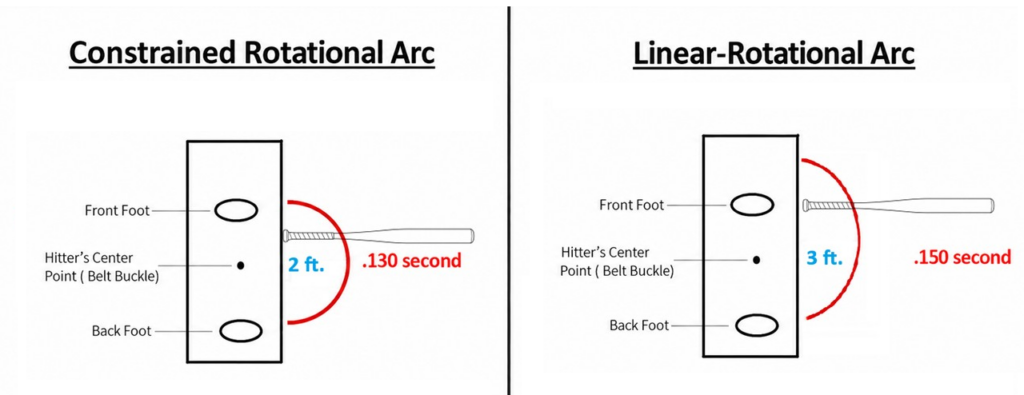
The image shows us something important. Both swings reach the same collision point with essentially the same barrel orientation. If the pitch is the same and the vertical collision geometry is the same, the spray direction would be the same as well. In other words, different swing paths or arc types can still produce the same directional result at contact. That means the path itself is not the whole story. The real question is what each path allows, and what each path limits, before the ball is struck.
This is where the tradeoff begins. The shorter arc gets the barrel there by reducing how far the barrel travels. The longer forward-working arc gives the barrel more distance over which to keep building speed. That raises a fair coaching question: if the hitter shortens the barrel’s trip, does he also reduce the distance available to create and transfer barrel speed? That is part of the tradeoff that often gets ignored when shorter is automatically treated as better.
The shorter arc also brings the barrel into the hitting area earlier, and that’s often treated as a built-in safety net for timing errors. The common assumption is that once the barrel is in the zone, a late swing simply sends the ball to the opposite field. That’s not how swing timing works. As the swing progresses, the sweet spot is continuously changing depth, direction, orientation, and height. A later collision is not the same barrel geometry shifted farther back in the zone. It’s a different collision. Once the barrel begins turning around the hitter sooner, more of its path is already committed, so mistiming can change far more than spray direction. It can change barrel orientation, vertical position, and the quality of the collision itself. Therefore, the shorter arc may be reducing the range of useful adjustments available after launch.
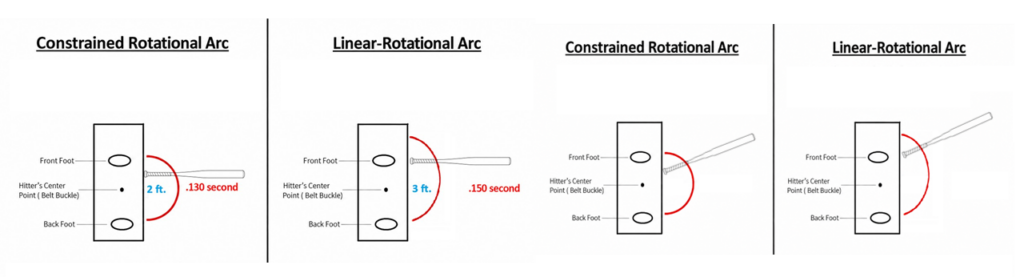
The second comparison in the above image shows how the two paths separate even more as the barrel continues to turn. In the constrained rotational pattern, continued torso rotation becomes responsible for carrying the hands and barrel around the body. That movement is transmitted through more rigid, or frozen, couplings, often described in this model as an intentional deceleration of the barrel. The effect is to make the barrel more dependent on the rotation of the larger body segments rather than allowing it to continue reorganizing freely around the hands.
In the linear-rotational pattern, the hands continue working forward into extension while the barrel turns around them through natural wrist articulation. That extension allows the barrel to keep moving forward before it begins to rise as it passes the hands. Turning the barrel and lifting the barrel are not the same thing. When continued torso rotation is driving the turn, the barrel can begin climbing earlier as part of the larger rotational movement. When extension is preserved, the barrel can continue changing direction while staying forward longer, with the barrel beginning its upward path later, after it has moved past the hands.
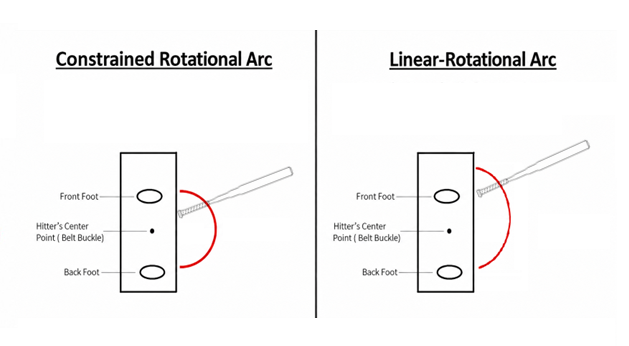
That has a direct effect on contact quality. Even when the pitch is traveling through the exact same tunnel, allowing it to reach a deeper collision point does not simply move contact farther back. The ball is now meeting the barrel at a different point in its three-dimensional path. In the constrained rotational pattern, the barrel may already be farther through its turn and farther into its upward movement by the time the pitch reaches that deeper location. The barrel center is therefore more likely to have risen above the center of the baseball, increasing the likelihood of contacting the upper portion of the ball and producing a ground ball.
The horizontal collision geometry can change at the same time. As the barrel continues around the hitter, its orientation and direction of travel are also changing, so a deeper collision on the same pitch tunnel can alter spray direction as well as launch angle. A late collision is not simply the same collision shifted farther back. It can involve a different barrel height, a different barrel angle, and a different direction of barrel travel. Every good swing turns the barrel, but the way it turns determines how long useful collision geometry is preserved. If that turn carries the barrel upward and around the hitter too soon, the usable contact window narrows both vertically and horizontally.
For coaches, that is where the tradeoff becomes more important than the label attached to the swing. The timing advantage of the shorter arc has already been established as very small. What matters now is what the hitter may be giving up to create it. Earlier barrel entry can mean earlier barrel commitment. A shorter path can reduce the distance available for speed development, narrow the range of useful collision depths, and bring the barrel into its upward exit sooner. In that context, getting the barrel in early is only an advantage if the barrel can remain useful once it gets there.
That brings the discussion back to the original idea of letting the ball get deep. Deeper contact is not automatically better contact, and a shorter swing is not automatically a more efficient swing. Contact depth has to match pitch location, intended ball flight, and the geometry the barrel can still present when the ball arrives. Outside pitches can be handled deeper, inside pitches need to be caught farther out front, and a hitter trying to create loft may benefit from a more forward collision point. The better objective is to preserve as much useful collision space as possible while still producing speed, direction, and adjustability. A swing that gains a fraction more recognition time but gives up too much of that space may solve one problem by creating several others.