
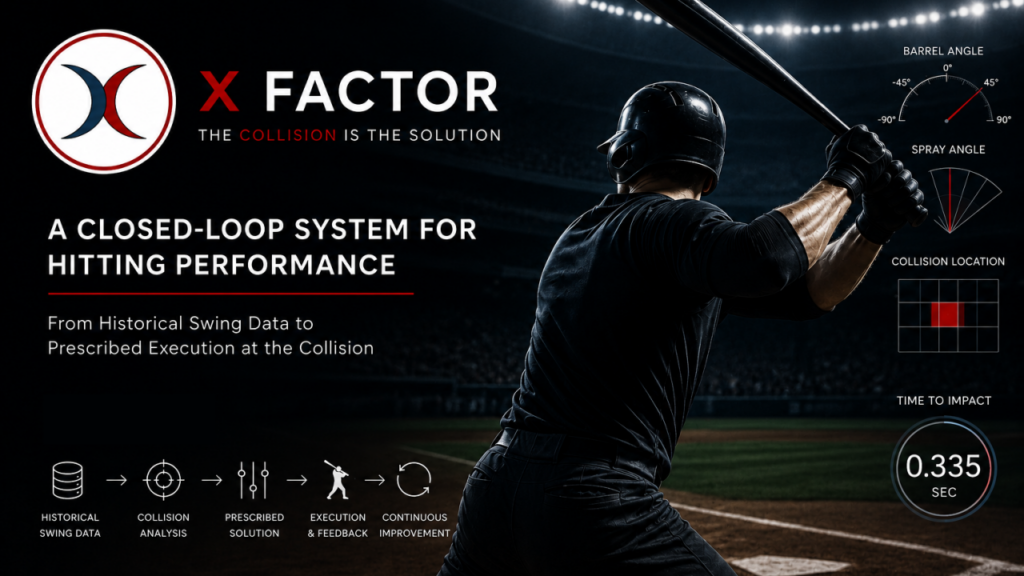
X Factor Technology's xFactor Hitting System: A New Architecture for Hitting
By Ken Cherryhomes ©2026
At X Factor Technology, we didn’t build a better light bulb or make an incremental improvement to an existing baseball product category. We created a new paradigm: a closed-loop architecture built from first principles by integrating disciplines that baseball and sports technology have traditionally treated as separate: neurobiology, control engineering, prescriptive data, and strategic intellectual property.
A better bat sensor, launch capture system, or a more advanced pitching machine improves an existing tool. X Factor does something fundamentally different. It defines the hitting event as an individualized temporal-spatial problem, calculates the required solution before the swing occurs, and closes the loop around that prescribed future state. Once the pitch parameters, collision condition, and hitter-specific Time to Impact are known, the system becomes deterministic: it can calculate when the hitter must respond, guide the hitter toward that solution in real time, measure the actual response, and quantify the error between prescribed and actual execution.
There is no conventional baseball technology category that fully describes that architecture.
A Single Pitch: How the System Solves the Hitting Event
The X Factor Hitting System begins with the prescribed bat-ball collision point, the terminal point of the pitch event, and works backward.
The demonstration below uses a 95-mph fastball traveling 53 feet from release to collision. The complete event lasts 396 milliseconds. The hitter’s measured response requirements are then applied to that event to determine when the response must begin and when the physical swing must begin.
Watch how the system establishes the collision point, applies the hitter’s individual Time to Impact, and solves backward along the pitch trajectory to calculate the required timing of the response.
Before the pitch reaches the hitter, X Factor has established the required temporal solution for that specific hitter against that specific pitch. The system is not simply measuring the swing after it occurs. It is calculating what must happen before execution begins.
The AI Swing Pilot delivering a precisely timed Swing Alert™ cue during a live pitch system testing, guiding the hitter’s response within the actual hitting event.
Neurobiology: The Human Constraint
The 185 milliseconds of Adjusted Reaction Time shown in the preceding example represents the interval from the hitter’s internal go message to the initiation of the physical swing. It is the human-response portion of the hitting event and incorporates the hard biological constraint of visuomotor delay.
At major-league pitch velocities, human reaction and motor execution consume the majority of the pitch-flight event. That biological requirement is not treated as a secondary performance statistic. It is a governing input to the solution.
Conventional swing-analysis technologies can measure mechanical swing time, but swing time represents only one portion of the hitter’s total temporal requirement. X Factor separately measures Adjusted Reaction Time and mechanical swing time, then combines them as Time to Impact. TTI establishes the total time the individual hitter requires from the internal go message through bat-ball collision.
That distinction is fundamental. A system that measures only swing time knows how long the bat requires to reach collision once the swing is underway. It does not know when the hitter’s response process had to begin.
At 95 mph, small errors in that missing temporal requirement translate into feet of pitch travel. Any analytical or predictive system attempting to calculate the required initiation point without measuring the individual hitter’s complete TTI must estimate the missing human-response component. Population averages or generalized assumptions may describe a group, but they cannot establish the hitter-specific temporal solution required for a particular pitch event.
X Factor measures the complete temporal requirement needed to solve backward from collision.
Control Engineering: The Mathematical Solution
The system applies closed-loop control logic to the hitting event.
Instead of starting with the result and working backward through descriptive statistics, X Factor begins with the collision point as the terminal condition. Pitch distance, velocity, trajectory, and location establish the available event. The hitter’s measured temporal requirements establish the time consumed producing the response.
From those constraints, the required response point can be calculated backward along the pitch trajectory.
That changes the fundamental question from:
“What happened on the swing?”
to:
“What had to happen for this hitter to arrive at the required collision point?”
Once the prescribed solution is known, actual execution can be measured against it. Timing error, spatial error, and response error become quantifiable rather than inferred from the final outcome.
The hitting event becomes a solvable temporal-spatial control problem.
Prescriptive Data: From Historical Record to Executable Training
X Factor’s analytical system is built around every recorded swing taken against MLB pitching since 2020, evaluated at the collision level rather than reduced to conventional outcome statistics.
Each swing is analyzed in the context of the pitch that produced it, including pitcher, pitch type, velocity, location, count, and sequence, while preserving the hitter’s collision characteristics, including barrel angle, spray angle, collision location, contact quality, and outcome.
This is fundamentally different from conventional MLB front-office analysis. Front-office models primarily use historical pitch and swing data to describe, value, and predict performance. X Factor uses the same historical environment to determine how hitters physically solved individual pitches at collision and to identify which collision relationships produced the strongest results.
The analytical focus therefore shifts from what happened after the swing to how the hitter arrived at the result. Barrel orientation, spray direction, collision geometry, pitch condition, and offensive outcome can be evaluated together across the complete historical swing population.
That collision-level history can then be converted into prescription. X Factor can identify the collision solutions associated with specific pitchers, pitch types, locations, counts, and sequences, recreate those conditions, and calculate the individualized temporal response required from the hitter.
From Prescription to Training Rep
Once the pitch condition and prescribed collision solution are established, the system converts that information into an executable training event.
The pitch is recreated at the required velocity, location, and movement profile. Count, sequence, pitcher tendencies, and game situation define the strategic context in which the pitch is presented. X Factor then applies the hitter’s measured Time to Impact to calculate when the response must begin relative to that specific pitch.
During guided training, a swing cue is issued at the calculated response point. The hitter responds and executes the swing against the recreated pitch.
At collision, the system compares what actually occurred with what was prescribed. The hitter’s timing, collision depth, barrel orientation, and resulting contact can be measured against the intended solution.
The next pitch can then be adjusted, repeated, sequenced, or presented without the cue, allowing the system to move from guided execution into retention testing and game-like decision training.
Each rep therefore follows the same closed-loop sequence: prescribe the required solution, recreate the event, cue the hitter when appropriate, measure the response, compare actual execution with the prescription, and use the resulting error to inform the next rep.
Once that process is established at the individual-pitch level, the same architecture can be extended across pitch sequences, counts, pitcher tendencies, and game situations.
Historical sequencing becomes trainable. Count-specific approach plans become executable. Opponent preparation, swing-decision training, timing instruction, collision geometry, and physical execution become parts of the same closed-loop system.
MLB front-office analytics uses historical performance primarily to explain and predict what a hitter is likely to do.
X Factor uses historical collision-level swing data to determine what the hitter should do and the conditions required to do it.
Demonstrated, Not Theoretical
X Factor is pre-commercial, but it is not theoretical.
The core architecture has already been physically implemented and demonstrated in controlled pilot testing. The system has calculated individualized hitter timing requirements, delivered real-time swing cues within live pitch events, measured prescribed-versus-actual response, and demonstrated repeatable collision performance across changing pitch locations.
The architecture therefore did not emerge as an abstract model awaiting future implementation. The underlying methodology was built, tested, refined, and extended into a broader platform architecture.
Commercial availability is not the dividing line between concept and reality. X Factor has already established proof-of-function. The next stage is scale, integration, and commercialization.
Strategic Patent Protection: The Legal Moat
X Factor’s competitive moat is anchored by three granted U.S. utility patents and two pending patent applications directed at core elements of the system architecture.
The three granted patents protect foundational timing and cueing methodology, including individualized hitter-response measurement, decomposition of the hitting event into distinct temporal phases, and target-zone interaction without requiring physical ball contact. These protections extend beyond a particular display, sensor, or hardware configuration because they address functional methods required to measure and train the hitter’s temporal response.
There are also two pending applications extending the architecture into pitcher-batter video timeline analysis and hitter-anchored coordinate systems. Together, they protect additional temporal and spatial relationships required to evaluate the hitter relative to the pitch event and prescribed collision condition.
Continuation protection further extends the cue-delivery methodology into VR and AR embodiments, preserving the underlying architecture across physical and virtual training environments.
The strategic significance of the patent portfolio is architectural rather than product specific. The protection is directed at core methods used to measure the hitter’s temporal requirement, calculate and implement individualized timing prescriptions, establish hitter-relative spatial relationships, and connect those elements within the broader closed-loop system. The moat therefore protects critical pathways used to implement the architecture rather than a single sensor, display, training device, or software interface.
The Strategic Position
X Factor does not stand on an existing baseball-training architecture. It was not created by improving a bat sensor, adding analytics to a pitching machine, placing conventional training inside VR, or attaching a reaction-time test to an existing product.
It was built by treating hitting as a different problem.
Neurobiology defines the human constraint. Control engineering solves the temporal-spatial problem. Historical MLB data supplies realistic and strategically relevant events. Real-time cueing closes the instructional loop. Complete hitter TTI establishes the temporal requirement. Hitter-anchored coordinates establish the spatial reference. Three granted U.S. utility patents and two pending patent applications protect the critical pathways used to implement and extend the architecture.
The result is not another tool inside the existing baseball-development stack.
It is a new architecture for determining what an individual hitter must do, when the response must begin, where the collision must occur, and how far the actual execution deviated from the prescribed solution.
Traditional baseball technology measures what happened.
X Factor calculates what must happen.